
How Smart Sensors Are Transforming Waste Collection Routes?
Smarter waste collection is emerging as one of the most practical ways cities, businesses, and waste companies can cut emissions, lower costs, and improve public hygiene without waiting for new infrastructure. At the heart of this shift are smart sensors-small, connected devices placed in or on bins, compactors, and containers that monitor how waste is generated and when it really needs to be collected. Instead of sending trucks on fixed schedules regardless of whether bins are full or empty, sensor data allows operators to design dynamic routes that respond to real conditions on the ground. This article explores how these systems work, what they can realistically deliver, where they fall short, and how communities focused on sustainable living and circular economy goals can use them well.
From fixed schedules to data-driven routes
Traditional waste collection is built around fixed schedules and static routes. Trucks visit the same streets on the same days, often dictated by historical practice or labor agreements rather than up-to-date data. Studies by organizations such as Ellen MacArthur Foundation and various European municipalities have found that many containers are still less than half full when collected, while others in busy areas overflow between pickups. This mismatch wastes fuel, time, and money, and it contributes to litter, odors, pests, and public dissatisfaction.
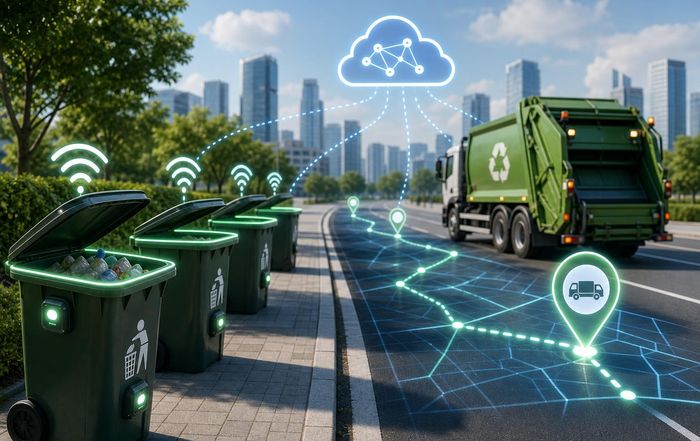
Smart sensors aim to replace guesswork with measurement. Ultrasonic or infrared fill-level sensors placed inside bins can estimate how full they are, while accelerometers and tilt sensors detect when containers have been emptied or moved. Temperature and gas sensors can flag fires or abnormal decomposition. These devices typically connect via low-power wide-area networks (LPWAN) or cellular connectivity to cloud platforms that aggregate and analyze the data. The result is a real-time map of bin status across a city, campus, industrial facility, or commercial portfolio-information that can be fed into route optimization software rather than relying on fixed timetables.
For readers thinking broadly about waste and resource efficiency, this shift is important because it makes everyday operations measurably more efficient with relatively modest changes to behavior and infrastructure, and it can complement broader sustainable living initiatives.
How smart sensor systems work in practice
A typical smart waste collection system has several interconnected layers. First are the sensors themselves, which may be battery-powered units installed in the lid of a container or integrated into "smart bins" supplied by manufacturers. These devices periodically measure fill level-often using ultrasonic pulses to gauge the distance to the top of the waste pile-and transmit the readings using communication standards such as NB-IoT, LTE-M, LoRaWAN, or Sigfox. Because battery life is critical, many systems send data only a few times per day or when significant changes occur.
The second layer is connectivity and data management. Telecom operators and specialized Internet of Things (IoT) platforms receive the sensor messages, handle device authentication and security, and forward data to waste management software. Companies and municipalities often work with established IoT providers or build on open standards guided by organizations like the LoRa Alliance or GSMA, which promote interoperability and low-power network design. This layer must deal with packet loss, coverage gaps, and roaming between networks in large metropolitan regions.
The third layer is analytics and route optimization. Software vendors and some in-house municipal teams apply algorithms that combine sensor readings with truck capacities, vehicle locations, road networks, traffic data, and labor constraints. Techniques from operations research and artificial intelligence-such as variants of the vehicle routing problem (VRP), constraint programming, and heuristic optimization-are used to determine which containers should be collected on which day and in what sequence. Over time, machine-learning models can also forecast when each bin is likely to fill based on patterns in weather, events, tourism, and local business activity.
Finally, the outputs must be operationalized. Drivers receive updated routes on in-cab tablets or smartphones, and managers monitor dashboards that show service levels, missed pickups, and container status. Integration with municipal systems and business back-offices allows for billing, complaint handling, and regulatory reporting. When implemented well, this chain from sensor to steering wheel allows waste operators to switch from reactive, schedule-based work to proactive, condition-based collection.
Environmental and climate benefits
From a climate perspective, the most direct benefit of sensor-driven routing is reduced fuel consumption. The International Energy Agency estimates that road transport accounts for a significant share of urban emissions, and heavy-duty vehicles such as waste trucks are disproportionately polluting per kilometer. By eliminating unnecessary trips to half-empty containers and shortening routes, cities that have piloted smart collection often report double-digit percentage reductions in vehicle kilometers traveled. While exact figures vary, reductions of 20-40% in collection mileage have been documented in some European and North American deployments, according to case studies published by technology providers and municipal authorities.
Fewer truck miles translate not only into lower CO₂ emissions but also reduced local air pollutants such as NOx and particulate matter, which are a concern for public health agencies like the World Health Organization. In dense urban areas, cutting heavy-vehicle traffic can also improve noise levels and safety for cyclists and pedestrians. These environmental co-benefits make sensor-based routing attractive to city leaders trying to align with national climate commitments or frameworks promoted by networks such as C40 Cities.
Sensors can indirectly support higher recycling and better resource recovery as well. When operators know precisely how quickly different streams-such as paper, glass, or plastics-are filling, they can adjust container sizes and placement to reduce contamination and overflow. Overflowing recycling bins often lead residents to dump materials in general waste or on the street, undermining diversion targets. By keeping containers appropriately sized and serviced, municipalities can support cleaner plastic recycling and other material cycles. In some commercial settings, smart compactors linked to sensors also reduce haulage frequency, which further lowers emissions and costs.
Economic and operational gains for cities and companies
Beyond environmental gains, the financial and operational arguments for smart sensors are often what persuade decision-makers. Waste collection can account for a substantial portion of municipal solid waste budgets. According to the World Bank, collection and transport often represent the majority of costs in low- and middle-income cities, and still a large share in wealthier countries. Optimizing routes can therefore unlock savings without cutting service quality. Reduced truck mileage lowers fuel expenses, tire wear, and maintenance needs, while dynamic routing may allow operators to serve growing populations with the same or fewer vehicles and staff.
For private haulers and facility managers, data-driven routing enables more accurate service contracts and performance guarantees. Instead of flat monthly fees based on rough estimates, contracts can be tied to actual pickups or container usage, with data logs to support invoicing and dispute resolution. This can be particularly important for sustainable business clients that must report waste and recycling metrics as part of environmental, social, and governance (ESG) disclosures. Companies that manage multiple sites-such as retailers, hotel chains, or universities-can compare performance across locations, identify outliers in waste generation, and target interventions where they matter most.
Operationally, route optimization can smooth workloads and reduce overtime by balancing collection tasks across days and crews. Real-time alerts from sensors also allow quick response to exceptional situations-such as illegal dumping, fires, or blocked containers-before they escalate into health or safety problems. Some cities integrate smart waste dashboards into larger urban technology and innovation platforms, aligning collection with street cleaning, event management, and even flood prevention when drains are obstructed by litter.
Data, privacy, and worker impacts
Despite their promise, smart sensors raise important questions about data governance and human impacts. Although bin-level data may seem innocuous, patterns of waste generation can reveal sensitive information about households, businesses, or institutions. In jurisdictions with strong privacy laws-such as the European Union's GDPR-municipalities must ensure that data is anonymized or aggregated appropriately, and that residents understand what is being collected and for what purpose. Guidance from organizations such as the European Commission and national data-protection authorities emphasizes transparency and proportionality in smart city deployments.
Workers are another critical consideration. Route optimization can change long-standing routines and may be perceived as a threat to jobs or autonomy. Unions and labor organizations in some countries have expressed concern that digital monitoring could be used for performance surveillance rather than service improvement. Addressing these concerns requires involving crews early in the design process, providing training, and framing technology as a tool that improves safety and reduces unnecessary strain-such as fewer heavy lifts of nearly empty containers-rather than as a mechanism for job cuts. Experiences shared by cities through networks like ICLEI - Local Governments for Sustainability suggest that collaborative approaches can ease transitions and sometimes lead to upskilling opportunities for staff.
Data quality is another challenge. Sensors can fail, batteries can run out earlier than expected, and connectivity can be patchy, especially in underground containers or dense high-rise districts. Route optimization algorithms must therefore be robust to missing or noisy data and incorporate manual overrides when crews report on-the-ground conditions that conflict with the system's view. Over-reliance on automation without feedback loops can undermine trust among operators and residents.
Technology choices and standards
The smart sensor ecosystem is diverse, with numerous vendors offering hardware, platforms, and end-to-end solutions. Cities and companies must navigate choices in connectivity, device design, and software architecture. Low-power networks such as LoRaWAN and Sigfox promise long battery life and low operating costs but may require dedicated gateways or partnerships with specialized providers. Cellular IoT options like NB-IoT and LTE-M, championed by telecom industry bodies such as the GSMA, offer broader coverage and integration with existing infrastructure but may have higher subscription costs.
Battery life is a central technical constraint. Many deployments aim for five to ten years of operation without replacement, which requires careful calibration of transmission frequency, power levels, and firmware efficiency. Harsh conditions-such as extreme temperatures, high humidity, or corrosive waste-can shorten device lifespans. Independent testing by research institutes and standards organizations, including groups associated with the International Telecommunication Union (ITU), can help buyers evaluate claims and avoid lock-in to proprietary ecosystems that may not be future-proof.
Open standards and interoperability are increasingly emphasized by smart city initiatives promoted by bodies like the OECD and UN-Habitat. When data from waste sensors can be combined with other urban datasets-traffic flows, energy usage, public transport-cities can design more holistic sustainability strategies. However, this integration also increases the stakes for cybersecurity. Municipal systems have been targets for ransomware and other attacks, making it essential to adopt secure device management, encryption, and access controls from the outset.
Integrating sensors into broader sustainability strategies
Smart waste routing should not be seen as a standalone fix but as one component of a wider transition toward circular, low-carbon urban systems. For communities focused on environmental awareness and climate change, sensor data can become a powerful educational and planning tool. Aggregated insights about how much waste different neighborhoods generate, or how seasonal events affect litter, can inform targeted campaigns to reduce single-use plastics, promote reuse schemes, or redesign public spaces to minimize waste.
Businesses pursuing greener operations and more resilient economies can use smart collection data to redesign packaging, adjust procurement, or collaborate with suppliers on take-back programs. Universities and schools, which often serve as testbeds for sustainability innovation, can integrate sensor-enabled bins into curricula that teach students about data, systems thinking, and the environmental impacts of consumption. International organizations such as the United Nations Environment Programme (UNEP) and OECD have highlighted data-driven waste management as a key enabler for achieving Sustainable Development Goals related to responsible consumption, climate action, and sustainable cities.
At a neighborhood level, visible smart bins and cleaner streets can reinforce community engagement. When residents see that separating recyclables leads to less overflow and fewer truck visits, they may be more willing to participate in sorting schemes. However, this requires clear communication; simply installing sensors without explaining their purpose can create suspicion or unrealistic expectations. Municipalities that share high-level performance dashboards or periodic reports often find it easier to build support for investments and behavior-change initiatives.
Barriers, inequities, and realistic expectations
Not all cities or regions can easily adopt smart sensor systems. Upfront costs for hardware, software, and organizational change can be significant, especially where budgets are already stretched. In low-income or rapidly growing urban areas, basic collection coverage may still be the priority, and advanced optimization tools could be seen as a luxury. The World Bank and UN-Habitat have both noted that technological solutions must be matched to local capacity and governance structures; in some contexts, improving basic infrastructure, worker protections, and community engagement may achieve more immediate gains than deploying sensors.
There is also a risk that smart waste technologies deepen inequalities if they are rolled out primarily in affluent districts or commercial centers while informal settlements and marginalized neighborhoods continue to suffer from inadequate or irregular service. Equity considerations should be built into project design, ensuring that data-driven improvements strengthen, rather than fragment, citywide systems. Partnerships with civil-society organizations and local leaders can help identify priorities and avoid blind spots.
Realistic expectations are important. Smart sensors cannot by themselves solve systemic issues such as overconsumption, global plastic production, or inadequate recycling markets. They are tools that make collection more efficient and transparent, but they do not eliminate the need for upstream waste prevention, product redesign, and stronger regulatory frameworks. Policymakers drawing on guidance from bodies such as the European Environment Agency or US Environmental Protection Agency should view smart routing as a complement to, not a substitute for, measures like extended producer responsibility, deposit-return schemes, and landfill taxes.
How communities and organizations can get started
For municipalities, campuses, and companies considering smart sensors, starting small and learning quickly is often better than attempting a citywide rollout at once. Pilot projects in representative districts-mixing residential, commercial, and public spaces-can reveal how local waste patterns behave and whether the technology is robust under real-world conditions. Performance indicators might include reductions in truck mileage, fuel use, overtime hours, overflow incidents, and complaints, as well as changes in recycling rates.
Engagement with workers, residents, and other stakeholders from the outset is crucial. Workshops, driver feedback sessions, and public information campaigns can help align expectations and surface practical issues, such as where to place sensors to avoid vandalism or how to integrate new routes with existing shift structures. Many cities share their experiences through international networks, and reading case studies from organizations like C40 Cities, ICLEI, and national municipal associations can help avoid common pitfalls.
For happy people interested in everyday lifestyle choices, supporting data-driven waste improvements may be as simple as participating in local consultations, reporting overflowing bins through official apps, or advocating for transparent metrics in municipal sustainability plans. Businesses can ask service providers whether they use sensor-based routing, how they protect data, and how they report environmental performance. In all cases, the goal is to ensure that technology serves broader social and environmental objectives rather than becoming an end in itself.
Rethinking waste collection as an intelligent service
Smart sensors are quietly reshaping how waste is collected, turning a historically low-tech, schedule-driven service into a responsive, data-informed system. By measuring what was previously invisible-the real-time status of thousands of containers-they allow cities and companies to cut unnecessary truck journeys, reduce emissions, save money, and improve cleanliness. The most successful implementations treat sensors and routing algorithms as part of a larger ecosystem that includes worker knowledge, citizen engagement, and upstream efforts to reduce and redesign waste.
As more communities explore pathways to cut carbon and build resilient, livable environments, intelligent waste collection offers a relatively accessible opportunity: it builds on existing trucks and bins, relies on mature IoT technologies, and can deliver measurable results within a few years. The challenge is not only technical but institutional-aligning policies, budgets, and behaviors so that the data generated by sensors leads to better decisions. For those committed to more sustainable cities and businesses, understanding and shaping this transition is an important piece of the wider effort to save resources and protect the planet.
