
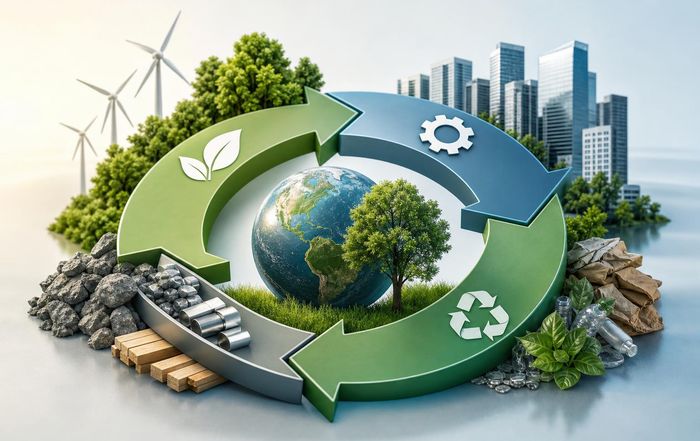
Business Benefits of Circular Resource Planning
Circular Resource Planning in a Decisive Decade
As climate risk, resource scarcity and stakeholder expectations converge into a single strategic agenda, circular resource planning has moved from niche sustainability discourse into the core of competitive business strategy. For the groovy, funky party and knowledge seeking people on YouSaveOurWorld, who are already attuned to the intersections between sustainable living, climate action and resilient business models, circular resource planning represents not only a technical framework for managing materials and waste, but also a profound redesign of how value is created, captured and preserved over time. While traditional linear models of "take-make-dispose" still dominate many sectors, the most forward-looking organizations now treat resources as assets to be cycled, regenerated and shared, aligning operational efficiency with environmental responsibility and long-term economic performance.
Circular resource planning can be understood as the structured process through which a company anticipates, designs and manages the flow of materials, products, by-products and energy across their full life cycle, with the explicit aim of minimizing waste, maximizing reuse and extending asset life in a way that is economically viable and strategically advantageous. This approach builds on the principles of the circular economy and industrial ecology, but translates them into practical decision-making tools for finance, operations, procurement, design and strategy teams. As businesses confront rising regulatory pressures, volatile commodity prices and increasing investor scrutiny, the organizations that embed circular thinking into planning processes are demonstrating measurable gains in profitability, resilience and brand equity. Readers seeking a broader context on how circular approaches connect to everyday choices can explore the platform's dedicated perspective on sustainable living, where personal decisions are linked to systemic change.
From Linear to Circular: A Structural Shift in Business Logic
The traditional linear model of resource use, in which raw materials are extracted, transformed into products and ultimately discarded as waste, was built for a world that assumed cheap inputs, abundant sinks for pollution and limited regulatory oversight. This model is increasingly incompatible with the planetary boundaries described by organizations such as the Stockholm Resilience Centre, and with the climate science consolidated by the Intergovernmental Panel on Climate Change (IPCC), which underlines the need to decouple economic growth from material throughput and emissions. Businesses that continue to rely on linear supply chains face mounting exposure to resource price shocks, reputational risk and stranded assets as policies tighten and customer expectations evolve. Those who wish to understand the broader climate implications of linear systems can refer to the analysis on climate change published on this site.
Circular resource planning challenges this outdated logic by treating resources not as consumables but as stocks of value that can be maintained, upgraded, shared and reintroduced into production loops. This does not mean simply adding recycling programs at the end of a product's life; rather, it requires integrating circularity into product design, procurement criteria, manufacturing processes, logistics strategies and business models. Companies like Philips, Renault and Interface have demonstrated, through their own circular initiatives, that designing for disassembly, modularity and remanufacturing can reduce material costs while opening new revenue streams in services and product-as-a-service offerings. Readers interested in the strategic implications for corporate models can explore how circularity intersects with sustainable business practices, where financial performance and environmental integrity are treated as mutually reinforcing.
Cost Efficiency, Margin Protection and Resource Security
One of the most immediate and tangible benefits of circular resource planning is its impact on cost structures and margin stability. In a world where commodity prices for metals, plastics and critical minerals are increasingly volatile, companies that depend heavily on virgin inputs face unpredictable production costs and supply disruptions. By contrast, organizations that adopt circular planning can gradually substitute primary materials with secondary ones, harvested from internal waste streams, customer returns or industrial symbiosis partnerships, thereby reducing their exposure to external shocks and improving their ability to forecast costs. The Ellen MacArthur Foundation has highlighted multiple case studies where circular strategies have led to double-digit cost reductions, particularly in sectors such as automotive, electronics and construction.
Circular planning also supports more efficient asset utilization, which directly influences profitability. When businesses design products for longer lifetimes, repairability and upgradability, they can extend revenue generation from existing assets through maintenance services, refurbishment programs and resale channels, rather than relying solely on continuous new production. This is particularly evident in technology and equipment-intensive industries, where predictive maintenance, remanufacturing and leasing models help spread capital costs over longer periods and larger customer bases. For readers of YouSaveOurWorld.com interested in how these dynamics tie into broader economic systems, the section on the green and circular economy offers a more macro-level perspective on how resource productivity supports sustainable growth.
Revenue Innovation and New Circular Business Models
Beyond cost savings, circular resource planning opens pathways to entirely new revenue models that align with shifting customer preferences and regulatory landscapes. As consumers, businesses and public institutions increasingly prioritize durability, reparability and sustainability, companies that embed circularity into their planning processes can differentiate themselves through service-based offerings, product take-back schemes and collaborative consumption platforms. The transformation of traditional product sales into subscription or performance-based models, exemplified by initiatives such as Michelin's tire-as-a-service programs or Rolls-Royce's "Power by the Hour" engine service model, illustrates how circular thinking can convert what was once a one-time transaction into a long-term relationship built on shared value and resource efficiency.
Circular resource planning provides the data and structural visibility required to design such models effectively, since it compels organizations to map material flows, understand product life cycles and quantify the residual value of components and materials. In sectors such as electronics, furniture and industrial machinery, companies are increasingly establishing certified refurbishment centers, buy-back programs and secondary marketplaces, thereby capturing value that would otherwise be lost to informal or unregulated channels. For readers who want to connect these innovations to broader trends in sustainable enterprise, YouSaveOurWorld.com provides a dedicated lens on business transformation and sustainability, where circular business models are discussed alongside governance, risk and strategy considerations.
Risk Management, Compliance and Investor Confidence
In 2026, regulatory momentum around waste, emissions and product responsibility has accelerated significantly, particularly in the European Union, where instruments such as the EU Circular Economy Action Plan, the Waste Framework Directive and the Eco-design for Sustainable Products Regulation are reshaping how companies design, manufacture and market their products. Similar trends can be observed in other jurisdictions, from extended producer responsibility schemes in Canada and Japan to evolving disclosure standards under frameworks such as the Task Force on Climate-related Financial Disclosures (TCFD) and the International Sustainability Standards Board (ISSB). Circular resource planning equips companies to anticipate and comply with this expanding regulatory landscape by embedding lifecycle thinking into their core planning and reporting processes, reducing the risk of non-compliance, fines and reputational damage.
From an investor relations perspective, circular planning signals that a company is proactively managing material risks related to resource dependency, waste liabilities and climate exposure. Long-term institutional investors, sovereign wealth funds and impact investors increasingly scrutinize how portfolio companies address these issues, often referencing frameworks such as the UN Principles for Responsible Investment (UN PRI) and sector-specific guidance from organizations like CDP. Businesses that can demonstrate robust circular strategies, supported by credible data on material recovery, waste reduction and product longevity, are better positioned to attract capital, negotiate favorable financing terms and maintain their social license to operate. Those who want to deepen their understanding of how circularity intersects with environmental risk can explore the platform's content on environmental awareness and responsibility, which situates corporate actions within broader ecological and societal impacts.
Strengthening Brand, Customer Loyalty and Market Differentiation
Brand value and customer loyalty are increasingly influenced by perceptions of environmental responsibility and resource stewardship, particularly among younger demographics and professional procurement teams guided by sustainability criteria. Circular resource planning enables companies to make credible claims about the durability, reparability and recyclability of their products, backed by transparent data and third-party certifications from organizations such as Cradle to Cradle Products Innovation Institute or B Corp. These assurances go beyond generic "green" messaging, demonstrating that the organization has systematically integrated circularity into its design, sourcing and end-of-life management practices.
In consumer markets, brands that offer repair services, trade-in programs and clearly labeled recyclability information often see higher customer retention and positive word-of-mouth, as customers feel empowered to participate in a more responsible consumption pattern. In business-to-business markets, circular commitments can become a decisive factor in procurement processes, particularly when public institutions and multinational corporations adopt sustainable purchasing policies aligned with guidance from entities such as the OECD and the World Business Council for Sustainable Development. Readers who wish to connect these branding and customer dynamics with lifestyle trends can consult the site's exploration of sustainable lifestyle choices, where personal values and corporate behavior intersect in the marketplace.
Operational Resilience and Supply Chain Stability
The disruptions of recent years, from pandemic-related supply chain breakdowns to extreme weather events linked to climate change, have underscored the vulnerability of globalized, just-in-time supply chains that depend on linear material flows. Circular resource planning contributes to operational resilience by diversifying material sources, increasing local recovery and reuse, and reducing dependence on single-source suppliers or distant geographies. By developing closed-loop systems for key materials, companies can maintain production even when external inputs are constrained, while also reducing lead times and logistics costs.
Moreover, circular planning encourages closer collaboration with suppliers, logistics partners and downstream customers, as material loops often require shared infrastructure, data and standards. This collaborative approach can lead to industrial symbiosis, where the by-products of one process become the inputs of another, as documented in pioneering initiatives like Kalundborg Symbiosis in Denmark. Such arrangements not only reduce waste and emissions but also create mutual dependencies that strengthen business relationships and collective resilience. For readers interested in the global dimension of these supply chain transformations, YouSaveOurWorld.com offers perspectives on global sustainability challenges and responses, situating circular practices within international trade and development contexts.
Innovation, Technology and Data-Driven Circularity
Circular resource planning is both a driver and a beneficiary of technological innovation. Digital tools such as the Internet of Things, advanced analytics, digital twins and blockchain enable companies to track materials, monitor asset performance and verify the provenance and condition of components across their life cycle. This data is essential for designing effective take-back programs, optimizing maintenance schedules, and determining when it is most economical and environmentally beneficial to repair, refurbish or recycle. Technology companies like SAP, Microsoft and Schneider Electric are developing specialized solutions that integrate circular metrics into enterprise resource planning and product lifecycle management systems, helping businesses operationalize circular strategies at scale.
At the same time, innovation in materials science, product design and manufacturing techniques, including additive manufacturing and bio-based materials, expands the possibilities for circularity by making products more modular, easier to disassemble and more compatible with high-quality recycling or composting. For readers of YouSaveOurWorld.com, the intersection of circularity and digital transformation is explored further in the sections on sustainable technology trends and innovation for environmental impact, where case studies illustrate how data-driven insights and design thinking converge to enable new forms of resource efficiency and low-carbon value creation.
Design for Circularity and the Role of Product Development
Design decisions determine the majority of a product's environmental impact and circular potential, often before a single unit is manufactured. Circular resource planning therefore places significant emphasis on design for disassembly, modularity, standardization of components and the selection of materials that can be safely and efficiently recovered at end of life. Leading design consultancies and in-house teams within companies such as IKEA and Patagonia are increasingly using lifecycle assessment tools and circular design guidelines to ensure that new products are not only attractive and functional, but also compatible with repair, refurbishment and recycling systems.
In practical terms, this may involve designing products with fewer composite materials, using standardized fasteners instead of permanent adhesives, providing access to spare parts and repair manuals, and ensuring that materials are clearly labeled for sorting and processing. These choices can have significant business benefits, as they reduce the cost and complexity of reverse logistics, increase the value of recovered materials and support the development of secondary markets. Readers who wish to explore how design thinking supports circular strategies can consult the site's perspective on sustainable design and systems thinking, where aesthetics, functionality and environmental performance are examined as integrated dimensions of product development.
Waste Reduction, Plastic Management and Circular Resource Flows
Waste is, in many respects, the most visible symptom of linear resource planning, and its reduction is a central objective of circular strategies. By mapping material flows and identifying where value is lost, companies can redesign processes to minimize offcuts, packaging waste, product returns and obsolescence. This is particularly critical in the context of plastic waste, where mismanaged materials contribute to marine pollution, microplastic contamination and greenhouse gas emissions. Circular resource planning encourages companies to reduce unnecessary plastic use, shift toward reusable or refillable packaging systems, and design products that are compatible with high-quality mechanical or chemical recycling.
Organizations such as UN Environment Programme (UNEP) and OECD have documented the economic and environmental costs of plastic pollution, as well as the opportunities associated with circular solutions. Businesses that proactively address plastic waste through circular planning not only reduce disposal costs and regulatory risk, but also respond to growing public concern and policy initiatives, including emerging global plastics agreements. For readers of YouSaveOurWorld.com, the dedicated section on plastic recycling and circular solutions offers practical insights into how both businesses and individuals can contribute to a more sustainable plastics economy, while the page on waste and resource management broadens the lens to encompass other material streams.
Education, Culture and Organizational Capability Building
The transition to circular resource planning is not solely a technical or operational challenge; it is also a cultural transformation that requires new skills, mindsets and collaborative practices across the organization. Employees in design, procurement, finance, operations, marketing and customer service all need to understand how their decisions influence material flows, lifecycle impacts and circular value creation. Companies that invest in training, internal communication and cross-functional collaboration are more likely to embed circular thinking into everyday decision-making and avoid treating it as a siloed sustainability initiative. Guidance from institutions such as UNESCO and World Economic Forum on education for sustainable development and future skills highlights the importance of systems thinking, lifecycle literacy and interdisciplinary collaboration in building circular capabilities.
For readers of YouSaveOurWorld.com, this cultural dimension connects directly with the platform's focus on education for sustainability and climate literacy, where the development of knowledge, skills and values is framed as a prerequisite for meaningful change. By fostering internal champions, establishing clear circular objectives and integrating circular criteria into performance metrics, businesses can ensure that circular resource planning becomes a shared responsibility rather than a specialized niche.
Circular Resource Planning, Well-Being and the Future of Work
While the primary business benefits of circular resource planning are often described in terms of cost, risk and revenue, there is a growing recognition that circular models can also contribute positively to personal well-being and the quality of work. By emphasizing durability, repair and local service networks, circular strategies can create skilled jobs in maintenance, refurbishment and remanufacturing, which are often more resilient to automation and offshoring than low-skilled assembly or extraction roles. Organizations such as the International Labour Organization (ILO) and OECD have noted that circular economy transitions, if well-managed, can support decent work, skills development and regional economic revitalization.
For individuals, circular products and services can enhance well-being by providing more reliable, longer-lasting goods, reducing exposure to hazardous materials and encouraging more thoughtful consumption patterns that align with personal values. This connection between circular business practices and human well-being is explored on YouSaveOurWorld.com in the section on personal well-being and sustainable choices, where the psychological and social dimensions of sustainability are considered alongside environmental and economic factors.
Positioning Circular Resource Planning at the Heart of Planning
As time progresses, the evidence is increasingly clear that circular resource planning is not a peripheral sustainability initiative but a core element of sound business strategy, particularly for organizations that wish to remain competitive in a world defined by climate constraints, resource volatility and evolving stakeholder expectations. Companies that integrate circular principles into their planning processes are better positioned to control costs, innovate new revenue models, comply with tightening regulations, strengthen their brands, build resilient supply chains and attract talent and investment aligned with long-term value creation.
For the beautiful, fit, digital nomad community engaged with YouSaveOurWorld, circular resource planning represents a practical and strategic bridge between corporate decision-making and the broader societal goals of climate stability, ecosystem preservation and equitable prosperity. By aligning business models with the realities of a finite planet and the aspirations of a more conscious marketplace, circular resource planning offers a pathway to reconcile growth with responsibility. Those who wish to take a more holistic view of how circularity can be integrated into corporate and personal choices can explore the site's main portal at YouSaveOurWorld.com, where themes of sustainability, innovation and global citizenship are woven together, and can delve deeper into the interrelated topics of sustainable business, climate change, technology and innovation and sustainable living that collectively frame the business benefits of circular resource planning as part of a wider movement toward a regenerative, resilient and prosperous future.
