
How Green Technology Supports Smarter Waste Management in 2026
A Turning Point for Waste in a Warming World
By 2026, the global conversation about climate, resources, and the economy has converged on a single inescapable reality: waste is no longer a peripheral issue but a central strategic concern for governments, businesses, and communities. From overflowing landfills to plastic-choked oceans, the consequences of linear "take-make-dispose" models have become both visible and economically costly. In this context, green technology has moved from being a niche sustainability tool to a core enabler of smarter, data-driven waste management systems that align environmental responsibility with long-term competitiveness and social stability.
For YouSaveOurWorld.com, which has consistently emphasized the connection between everyday choices and global outcomes, the story of green technology in waste management is deeply personal and mission-critical. The platform's focus on sustainable living, responsible plastic recycling, and forward-looking sustainable business reflects a belief that waste is not an inevitable by-product of progress but a design and systems challenge that can be solved through innovation, education, and collective action.
The Strategic Context: Waste, Climate, and the Global Economy
Smarter waste management cannot be understood in isolation from broader climate and economic dynamics. According to analyses from organizations such as the World Bank, solid waste generation is projected to continue rising in step with urbanization and income growth, especially in rapidly developing regions. At the same time, the Intergovernmental Panel on Climate Change (IPCC) has repeatedly underscored that waste-related emissions-particularly methane from landfills-are a non-trivial contributor to global warming, and that improved waste systems are among the fastest, most cost-effective mitigation options available. Those seeking a deeper scientific grounding can explore the IPCC's assessments to understand how waste intersects with climate pathways and carbon budgets.
In parallel, institutions like the Organisation for Economic Co-operation and Development (OECD) and the World Economic Forum have framed waste as a symptom of deeper structural inefficiencies in the global economy, where valuable materials are discarded rather than recirculated, and where the environmental costs of extraction, production, and disposal are often externalized. This has accelerated interest in the circular economy as promoted by organizations such as the Ellen MacArthur Foundation, where resources are kept in use for as long as possible through reuse, remanufacturing, and recycling, and where waste is designed out of systems wherever feasible. Learn more about circular economy principles and their implications for business strategy through the Ellen MacArthur Foundation's knowledge resources.
For the audience of YouSaveOurWorld.com, which spans environmentally aware consumers, professionals, and business leaders, this context reinforces why waste management is not a narrow technical problem but a cross-cutting issue that touches climate change, global supply chains, urban planning, public health, and the resilience of local and national economies.
Defining Green Technology in the Waste Context
Green technology in waste management refers to tools, systems, and processes that reduce environmental impact while improving efficiency, transparency, and value recovery across the entire lifecycle of materials. Rather than focusing only on end-of-pipe solutions, contemporary approaches emphasize prevention, smart collection, advanced sorting, and high-quality recycling, supported by digital intelligence and clean energy.
This includes sensor-enabled collection systems that optimize routes and reduce fuel consumption, artificial intelligence used to identify and sort materials in complex waste streams, digital platforms that connect waste generators with recyclers and secondary markets, and biological or chemical innovations that convert organic waste into energy, fertilizers, or new materials. By embedding green technology into the fabric of urban infrastructure and corporate operations, cities and companies can transform waste from a liability into a strategic resource.
Readers interested in a broader understanding of how technology shapes sustainability can explore the dedicated section on technology at YouSaveOurWorld.com, which connects digital transformation with environmental and social outcomes.
Smart Collection: Sensors, Data, and Route Optimization
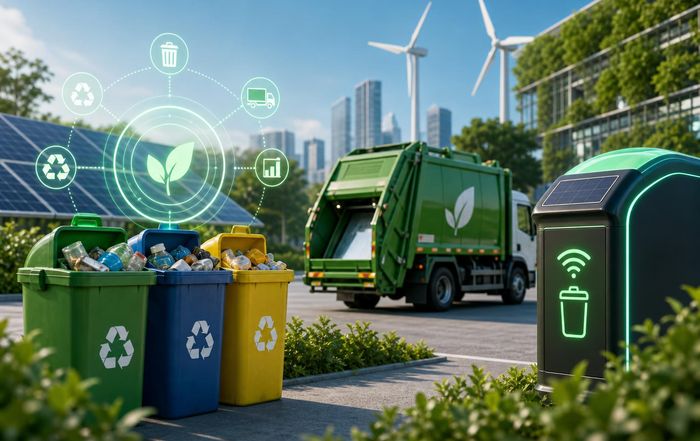
One of the most visible ways green technology is reshaping waste management is in the realm of collection. Traditional collection systems often rely on fixed schedules that do not reflect actual bin fill levels, leading to half-empty trucks, unnecessary fuel consumption, and avoidable emissions. In contrast, smart collection uses Internet of Things (IoT) sensors embedded in bins or containers to monitor fill status, temperature, and sometimes even material composition in real time.
Companies such as Enevo and Bigbelly pioneered this approach by deploying solar-powered compacting bins and sensor networks that communicate data to cloud-based platforms, allowing waste service providers to plan routes dynamically based on actual need. Municipalities in Europe, North America, and parts of Asia have reported significant reductions in collection costs and emissions when they transition to data-driven systems. For those seeking a technical overview of IoT and its applications in infrastructure, resources from the Institute of Electrical and Electronics Engineers (IEEE) provide detailed insights into standards and best practices in smart city deployments.
The integration of telematics and route optimization software means that waste collection can now be modeled as a logistics problem, similar to supply chain management in other sectors. By applying algorithms to minimize distance and time traveled, fleet operators can reduce fuel use, maintenance costs, and driver hours while maintaining or improving service levels. This directly supports the climate goals highlighted on YouSaveOurWorld.com and aligns with broader efforts to decarbonize transport and urban services.
Intelligent Sorting and Robotics: Unlocking the Value of Waste
Sorting has always been a critical bottleneck in recycling. Contaminated or mixed waste streams reduce the quality and market value of recycled materials, often leading to entire batches being landfilled or incinerated. Green technology has begun to transform this challenge through advanced sorting systems that combine high-speed mechanical processes with machine vision, robotics, and artificial intelligence.
Companies like AMP Robotics and ZenRobotics have demonstrated that AI-enabled robots can identify and sort materials on conveyor belts at high speed, using cameras and sensors to distinguish between different types of plastics, metals, paper, and other materials even when they are partially obscured or contaminated. By learning from large datasets, these systems continuously improve their accuracy, allowing material recovery facilities to extract more value from the same volume of waste and to create cleaner, more consistent material streams for downstream recyclers and manufacturers.
For plastics in particular, where chemical composition and additives can vary widely, spectroscopy-based systems using near-infrared or hyperspectral imaging have become crucial. Organizations such as Fraunhofer Institute and National Renewable Energy Laboratory (NREL) have supported research into these technologies, helping to improve the identification of complex polymers and multilayer packaging. Those who want to deepen their understanding of plastic flows and recycling technologies can consult the work of the United Nations Environment Programme (UNEP), which regularly publishes assessments on plastic pollution and policy responses.
On YouSaveOurWorld.com, the dedicated section on plastic recycling connects these technological advances with practical guidance for businesses and households, emphasizing that even the most sophisticated robotics and AI systems still depend on upstream behaviors such as proper sorting at the source and reductions in unnecessary packaging.
Digital Marketplaces and Data Platforms: Making Waste Visible and Valuable
A major barrier to smarter waste management has historically been the lack of reliable data. Without accurate information on volumes, composition, and flows of waste, it is extremely difficult to design effective policies, price signals, or business models. Green technology is changing this by creating digital platforms that track materials from generation to final destination, and that match waste generators with recyclers, processors, and buyers of secondary raw materials.
Startups and established firms alike have launched marketplaces where industrial by-products, surplus materials, and post-consumer recyclables can be traded in near real time. By providing transparency on quality, quantity, and location, these platforms reduce transaction costs and make it easier for companies to treat waste as a resource rather than a cost of doing business. The World Business Council for Sustainable Development (WBCSD) has documented numerous case studies where such platforms enable industrial symbiosis, in which the waste of one company becomes the input for another, thereby reducing both waste disposal and virgin material extraction.
In parallel, national and municipal governments are increasingly turning to digital waste information systems that integrate data from smart bins, collection fleets, material recovery facilities, and landfills. These systems support evidence-based policymaking, performance benchmarking, and public reporting. For example, the European Environment Agency has highlighted how digitalization supports the European Union's waste and circular economy directives by enabling more accurate tracking of recycling rates and landfill diversion. Readers interested in the policy dimension can explore EU circular economy resources to understand how data and regulation work together to drive systemic change.
For YouSaveOurWorld.com, which maintains a strong focus on business and economy, these developments illustrate how information transparency and digital infrastructure are becoming strategic assets. Companies that invest early in data-driven waste management systems not only reduce environmental risk but also gain insights into material efficiency, product design, and supply chain resilience.
Clean Energy, Bioeconomy, and Waste-to-Resource Pathways
While prevention and high-quality recycling are the priorities in any sustainable waste hierarchy, residual waste will continue to exist in the foreseeable future. Green technology is therefore also focused on minimizing the environmental impact of this residual fraction and, where possible, converting it into useful products or energy.
Anaerobic digestion is one of the most mature technologies in this domain, using microorganisms in oxygen-free environments to break down organic waste from households, agriculture, and industry into biogas and digestate. The biogas can be upgraded into biomethane and injected into gas grids or used as vehicle fuel, while the digestate can serve as a nutrient-rich fertilizer. The International Energy Agency (IEA) has recognized biogas and biomethane as important components of a low-carbon energy system, particularly in regions with strong agricultural sectors and food processing industries.
Similarly, advanced composting systems, often supported by digital monitoring of moisture, temperature, and oxygen levels, ensure that organic waste is transformed into high-quality compost with minimal odor and emissions. This supports regenerative agriculture and urban greening initiatives, which are increasingly seen as essential for climate adaptation and biodiversity.
For non-recyclable plastics and certain industrial wastes, chemical recycling and advanced thermal treatment technologies are being explored, though these remain controversial and must be carefully assessed against environmental and economic criteria. Research institutions and regulatory bodies, including the European Commission and the US Environmental Protection Agency (EPA), are actively studying the life-cycle impacts of such technologies to ensure that they do not simply shift pollution from one part of the system to another. Those interested in a more technical perspective can consult EPA resources on waste-to-energy and emerging recycling technologies.
On YouSaveOurWorld.com, the sections on waste and innovation highlight how these pathways fit into broader strategies that prioritize reduction, reuse, and recycling, while recognizing that responsible treatment of residual waste remains an important part of a comprehensive solution.
Design, Lifestyle, and the Front-End of Waste Prevention
Although much attention is rightly given to downstream technologies, truly smarter waste management begins long before a product reaches the bin. Design choices, consumption patterns, and cultural norms determine how much waste is generated and how easy it is to recover value at the end of life. Green technology can support these upstream interventions by providing tools for eco-design, product life-cycle assessment, and consumer engagement.
Designers and engineers increasingly rely on software that models the environmental impacts of different materials, manufacturing processes, and packaging options. By integrating life-cycle assessment tools, companies can identify hotspots in their product portfolios and redesign for durability, repairability, modularity, and recyclability. Organizations such as the Cradle to Cradle Products Innovation Institute promote design frameworks that consider material health, circularity, and social fairness, offering certification schemes that guide both producers and buyers toward more sustainable choices. Those interested in this design philosophy can explore Cradle to Cradle resources to see how leading brands are rethinking products from the ground up.
On the consumer side, digital platforms, mobile applications, and smart home devices can nudge individuals toward lower-waste lifestyles by providing information on product footprints, local recycling rules, and alternatives to single-use items. This aligns closely with the themes of lifestyle and personal well-being explored on YouSaveOurWorld.com, where the emphasis is on demonstrating that sustainable choices can enhance quality of life, reduce clutter and stress, and foster a stronger sense of connection with community and nature.
The design perspective also has a strong business dimension. By embracing circular design principles, companies can create new revenue streams through product-as-a-service models, take-back programs, and remanufacturing, thereby decoupling growth from resource use. Learn more about sustainable business practices through resources provided by organizations such as BSR (Business for Social Responsibility), which offers guidance on integrating circularity into corporate strategy and operations.
Policy, Education, and Cultural Change: Enabling Conditions for Technology
Green technology alone cannot deliver smarter waste management without supportive policy frameworks, robust education, and shifts in social norms. Extended producer responsibility (EPR) schemes, landfill taxes, deposit-return systems, and mandatory recycling targets create economic incentives that make investments in technology viable and align corporate behavior with societal goals. International bodies such as the United Nations Environment Assembly (UNEA) have advanced global discussions on plastic pollution and waste governance, signaling that regulatory momentum will continue to grow.
Education is equally crucial. Without public understanding of why and how to separate waste, reduce consumption, and support recycling markets, even the most advanced technologies will underperform. Schools, universities, and community organizations play a vital role in building environmental literacy and fostering a culture of stewardship. The education section of YouSaveOurWorld.com underscores that sustainability education is not just about conveying facts but about cultivating systems thinking, empathy for future generations, and a willingness to experiment with new ways of living and working.
Cultural narratives around convenience, status, and success also influence waste generation. Media, influencers, and business leaders can either reinforce disposable mindsets or champion repair, sharing, and sufficiency as attractive, modern choices. Learn more about how cultural change intersects with environmental awareness through resources from UNESCO, which has integrated education for sustainable development into its global agenda and provides extensive materials for educators and policymakers.
Corporate Leadership and Governance: From Compliance to Strategy
By 2026, leading companies no longer view waste management as a narrow compliance issue but as a core element of risk management, innovation, and brand differentiation. Investors, regulators, and customers increasingly expect transparency on waste generation, recycling rates, and circularity strategies. Frameworks such as those promoted by the Global Reporting Initiative (GRI) and the Task Force on Climate-related Financial Disclosures (TCFD) encourage organizations to disclose environmental performance and to integrate resource efficiency into governance structures.
Corporate leaders who take waste seriously often find that green technology investments generate multiple benefits: cost savings from reduced material use and disposal fees, resilience against resource price volatility, and opportunities to develop new products and services that meet the growing demand for sustainable solutions. The sustainable business and business content on YouSaveOurWorld.com emphasizes that this is not just a matter of corporate social responsibility but of long-term value creation and competitiveness.
Industry collaborations, such as sectoral coalitions on plastics or e-waste, demonstrate that shared infrastructure and standards can accelerate progress far beyond what individual firms could achieve alone. Learn more about such collaborations through organizations like the Global Plastics Alliance and the Platform for Accelerating the Circular Economy (PACE), which document best practices and facilitate cross-sector dialogue.
The Human Dimension: Well-Being, Equity, and Inclusion
Smarter waste management is not only about technology, policy, and economics; it is also about people. Informal waste pickers, sanitation workers, and recycling entrepreneurs form the backbone of waste systems in many regions, yet they often operate in unsafe conditions with limited social protection or recognition. As green technology reshapes waste management, there is a risk that automation and formalization could marginalize these workers unless inclusion is explicitly built into transition strategies.
Organizations such as UN-Habitat and the International Labour Organization (ILO) have highlighted the importance of just transition principles in waste and recycling sectors, advocating for policies that improve working conditions, provide training and upskilling opportunities, and integrate informal workers into formal systems with fair pay and social benefits. Those interested in the social justice dimension of environmental policy can explore ILO and UN-Habitat resources that address the intersection of urban development, labor rights, and sustainability.
For the community that gathers around YouSaveOurWorld.com, the link between environmental responsibility and personal well-being is a recurring theme. Cleaner neighborhoods, reduced pollution, and more equitable access to green jobs all contribute to physical and mental health, social cohesion, and a sense of shared purpose. Smarter waste management, supported by green technology, thus becomes a vehicle not only for ecological resilience but also for human flourishing.
Looking Ahead: A Systems Vision for 2030 and Beyond
As the world moves toward 2030 and the deadlines associated with the United Nations Sustainable Development Goals (SDGs), green technology in waste management will continue to evolve. Artificial intelligence will become more sophisticated, enabling predictive maintenance of waste infrastructure and real-time optimization of entire urban systems. Blockchain and other distributed ledger technologies may play a role in enhancing traceability and trust in recycled materials, helping to overcome concerns about quality and provenance.
At the same time, the fundamental questions will remain systemic rather than purely technical. How can societies redesign production and consumption to minimize waste generation in the first place? How can policy, culture, and markets be aligned so that circular practices become the default rather than the exception? How can the benefits of green technology be shared equitably across regions and social groups, avoiding new forms of digital or environmental inequality?
YouSaveOurWorld.com positions itself as a platform where these questions can be explored in an integrated way, connecting environmental awareness with practical guidance on sustainable living, business strategy, and innovation. By curating insights from science, policy, and real-world practice, and by highlighting stories of individuals, communities, and organizations that are already building smarter, greener waste systems, the site aims to empower its audience to act with confidence and creativity.
In 2026, the convergence of green technology, enlightened governance, and engaged citizenship offers a realistic pathway to transform waste from a symbol of excess into a cornerstone of a more resilient, equitable, and regenerative world. The challenge is significant, but so is the opportunity, and it is increasingly clear that the choices made today-in boardrooms, city halls, classrooms, and homes-will determine whether waste becomes a defining problem of the century or one of its most inspiring solutions.
