
Plastic Recycling in the UK: Why Local Rules Differ So Much
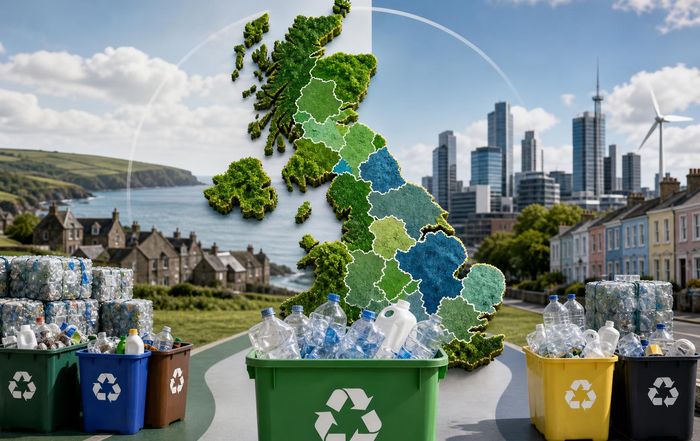
Walk down one street in Britain and you might be told to recycle plastic tubs, trays, and film in your household bin. Move a few miles and the local council may accept only bottles-and tell you to bin everything else. For residents who want to live more sustainably, these differences can be confusing and frustrating, and they raise a deeper question: if the UK is one country, why does plastic recycling vary so widely from place to place?
This educational feature unpacks the reasons behind those local differences, how the system is changing, and what practical steps people can take to navigate the patchwork of rules while still cutting plastic waste.
How UK recycling is organised: national goals, local systems
Understanding why rules differ starts with how waste is governed. In the UK, overall environmental goals and many regulations are set nationally, but the day-to-day responsibility for collecting and sorting household waste falls to local authorities. That split creates space for variation.
In England, the UK Government sets overarching targets and regulations through the Department for Environment, Food & Rural Affairs (DEFRA), while local councils choose what collection systems to operate. In Scotland, Wales, and Northern Ireland, devolved governments set their own strategies and targets, often going further or faster than England on recycling policy. Each local authority then designs its own collection scheme, contracts with waste management companies, and decides which materials it can practically collect and process.
Those local decisions are shaped by several factors: the infrastructure available (such as sorting plants and reprocessors), the contracts councils have signed, how much they can afford, and the types and quality of plastics that local facilities can handle. The result is a patchwork of collection systems rather than a single national model.
For people trying to make sense of this, it helps to see household recycling as just one part of a wider waste system that includes how products are designed, how packaging is labelled, and what markets exist for recycled material. Readers interested in how this fits into broader sustainable lifestyles can explore our pages on sustainable living and waste, where household choices are connected to larger economic and environmental trends.
The complexity of plastic itself: not all "plastic" is equal
Another major reason rules differ is that "plastic" is not one material but many. Household items labelled as plastic can be made from different polymers, each with its own properties, additives, and recyclability. The familiar resin identification codes (numbers 1-7 inside a triangle) are a rough guide, but they do not guarantee that something is recyclable in practice.
Common household plastics include PET (often used for drinks bottles), HDPE (milk bottles and detergent containers), PP (yoghurt pots, margarine tubs), and LDPE (plastic bags and some films). Some of these are widely recycled; others are technically recyclable but lack strong end markets or cost-effective processing routes. Mixed materials-such as plastic bonded with aluminium or paper-are even harder to recycle, and coloured plastics or those with certain additives can have lower value.
Recycling plants, known as material recovery facilities (MRFs), must be able to sort plastics into clean, separate streams that reprocessors can actually use. If a local facility only has equipment to handle bottles, the council may restrict collections to bottles, even if residents own many other plastic items. By contrast, a council that has access to a more advanced MRF-or that sends material to a regional plant shared with other authorities-may accept a wider range of plastics.
National bodies such as WRAP (the Waste and Resources Action Programme) and the UK Government have worked with industry to promote the idea of "designing for recyclability," encouraging packaging producers to use simpler, more recyclable materials and to avoid problematic formats. Internationally, organisations like the Ellen MacArthur Foundation have pushed for a circular economy approach, where plastic is kept in use and out of the environment. But until product design is more consistent, local recycling rules will continue to reflect what can realistically be sorted and sold, not just what is technically recyclable in a lab.
Economics and markets: why councils can't all collect the same plastics
Even when a plastic is technically recyclable, it might not be collected locally if there is no viable market for the recycled material. Councils operate under tight budgets; they must balance environmental ambitions with financial reality. Collecting, sorting, and transporting low-value plastics that no one wants to buy can be more expensive than sending them to energy-from-waste plants or landfill.
Prices for recycled plastics depend on global commodity markets. When virgin plastic made from fossil fuels is cheap, recycled material can struggle to compete. This volatility affects what waste management companies are willing to accept and what councils are prepared to fund. For example, clear PET bottles tend to have a strong market, especially when beverage companies are under pressure to include recycled content. By contrast, certain films, flexibles, and mixed plastics often have weaker or more unstable demand.
Some countries have used stronger regulation to create more stable markets. The European Union has minimum recycled content targets for some plastic products and packaging, and many EU states have advanced producer responsibility schemes that make producers pay more of the cost of managing waste. The UK is moving in that direction with new Extended Producer Responsibility (EPR) rules for packaging, but implementation has been slower and more complex than originally planned. Organisations such as Zero Waste Europe and OECD have highlighted how economic incentives shape what actually gets recycled, rather than what is theoretically recyclable.
For households, the economic details may be invisible, but they help explain why one council accepts plastic film and another does not. Where there is a reliable buyer for a particular plastic stream, councils are more likely to collect it. Where there is not, they may focus on materials with higher and more stable value, such as certain bottles, cans, and paper.
Infrastructure gaps: different facilities, different rules
Local recycling rules also mirror variations in infrastructure. Not every region has the same access to modern sorting plants, plastic reprocessors, or energy-from-waste facilities. Some councils own their own MRFs; others contract with private companies that operate large regional facilities; others rely on older plants with limited capabilities.
Modern MRFs use advanced optical sorting technologies, robotics, and automated quality control to separate different plastic types at high speed. These facilities can handle a broader range of items and achieve higher purity, making it easier to meet the quality standards required by reprocessors and manufacturers. Older facilities may rely more on manual sorting and be constrained to a narrower set of materials, often prioritising bottles and cans.
Investment in infrastructure is shaped by long-term contracts, planning decisions, and national funding programmes. In the UK, bodies such as UK Research and Innovation (UKRI) and the Environment Agency have supported innovation and regulation in waste infrastructure, while industry groups like the British Plastics Federation and RECOUP have promoted best practice. But upgrading facilities takes time, and councils tied into long contracts may be slower to adopt new collection systems.
The result is regional variation: some areas can process more complex plastic streams, while others must restrict what residents can put in their recycling bins. For readers interested in the technological side of recycling and resource efficiency, our innovation and technology sections explore how new systems and digital tools are reshaping waste management and the wider circular economy.
Devolved nations and policy divergence
Differences in plastic recycling rules are not just local; they also reflect diverging strategies across the UK's devolved governments. Wales, for example, has become one of the world's highest-performing recycling nations, thanks in part to a strong emphasis on separate collections and clear national guidance. The Welsh Government has pushed for consistent services and high capture rates, and many Welsh councils collect a broad range of recyclables.
Scotland has pursued its own circular economy agenda, with measures such as bans on certain single-use plastics and plans for wider reforms to packaging and waste systems. The Scottish Government and agencies like Zero Waste Scotland have promoted reuse and reduction alongside recycling. Northern Ireland has also developed its own waste strategies within the framework of UK-wide regulations.
In England, DEFRA has been working on a set of reforms intended to make collections more consistent, including proposals for "simpler recycling" and core materials that all councils would have to collect. These reforms are linked to Extended Producer Responsibility for packaging and a planned Deposit Return Scheme (DRS) for drinks containers. However, implementation has faced delays and revisions, and councils have expressed concerns about costs, timelines, and how national rules will interact with existing contracts and infrastructure.
International bodies like the UN Environment Programme (UNEP) and OECD have noted that multi-level governance can create both innovation and fragmentation: devolved regions can pioneer ambitious policies, but differences in timing and design can make systems more complex for citizens and businesses. In the UK, that tension is visible in the way plastic recycling rules vary not just between neighbouring councils, but also between nations.
Labelling, communication, and "wishcycling"
Even if infrastructure and markets were perfectly aligned, communication would still matter. Many people want to recycle as much plastic as possible, but confusing labels and inconsistent guidance make it hard to know what is genuinely accepted locally. This confusion can lead to "wishcycling"-putting items in the recycling bin in the hope that they can be recycled, even if the rules say otherwise.
Packaging labels in the UK have historically included a mix of symbols, from the "Mobius loop" arrow triangle to voluntary schemes like the On-Pack Recycling Label (OPRL). These labels aim to provide clearer guidance, often using phrases like "Recycle," "Check local recycling," or "Don't recycle." However, because local authority rules differ, a pack that is recyclable in one area may not be in another, and the "check locally" message can be vague.
Contamination-when non-target materials end up in recycling bins-can lower the quality of recyclate, increase processing costs, and even cause whole loads to be rejected and sent for disposal. Councils therefore try to balance ambition (collecting more materials) with simplicity (keeping rules clear enough that people can follow them). Some authorities have simplified schemes to reduce contamination, even if that means collecting fewer plastic types.
Public awareness campaigns by charities and NGOs such as Keep Britain Tidy and Greenpeace UK have highlighted both the importance and the limitations of recycling. They often stress that while recycling is necessary, it is not sufficient by itself; reducing plastic use and reusing items where possible are at least as important. For readers exploring broader environmental awareness and climate connections, our pages on environmental awareness and climate change provide additional context on how plastic fits into wider ecological challenges.
Upcoming reforms: will plastic rules become more consistent?
UK governments have recognised that a patchwork of local rules is confusing and undermines recycling performance. Several major reforms are intended to create more consistency and shift costs from taxpayers to producers.
Extended Producer Responsibility (EPR) for packaging is designed to make companies that place packaging on the market pay the full net cost of managing it at end-of-life. Under EPR, producers should have a stronger incentive to design packaging that is easier to recycle, and local authorities should receive funding that reflects the true cost of collection and sorting. DEFRA, the devolved governments, and regulators such as the Environment Agency and Scottish Environment Protection Agency (SEPA) are involved in designing and overseeing these schemes.
Alongside EPR, the UK plans to introduce a Deposit Return Scheme (DRS) for drinks containers, where consumers pay a small deposit that is refunded when they return the bottle or can. While the exact design and timing have been debated, DRS systems in other countries-highlighted by organisations like Eunomia and Reloop-have shown high return rates and cleaner material streams, particularly for PET bottles and aluminium cans.
"Simpler recycling" proposals aim to define a core set of materials that every council must collect, reducing confusion for residents who move between areas. The details and timelines have shifted, and there is ongoing discussion about how flexible councils should be, what to do with plastic films and flexibles, and how to coordinate changes with existing contracts. Nonetheless, the direction of travel is towards greater standardisation, at least for the most common packaging types.
These reforms will not eliminate every difference-geography, housing types, and local infrastructure will still matter-but they are likely to narrow the gap between the most and least comprehensive plastic recycling schemes. For businesses, this means stronger pressure to design packaging that fits into a more uniform system. For households, it should eventually mean fewer surprises when reading recycling guidance from one council to another.
What individuals can do in a confusing system
Even in a fragmented system, individual choices matter. But the most effective actions are not always intuitive, and they extend beyond simply putting more items in the recycling bin.
First, checking local guidance remains essential. Council websites and waste collection calendars typically list exactly which plastics are accepted and how they should be prepared (for example, rinsed, lids on or off, squashed or not). Following those rules closely reduces contamination and increases the chance that collected plastics are actually recycled. Where local guidance is unclear, residents can often contact the council or collection contractor directly for clarification.
Second, focusing on reduction and reuse can avoid waste altogether. Choosing products with minimal or refillable packaging, using reusable containers and bags, and avoiding unnecessary single-use plastics can cut demand for new plastic and reduce the volume that needs to be managed. This aligns with a broader shift towards sustainable living and more thoughtful lifestyle choices that benefit both the environment and personal well-being.
Third, supporting businesses and initiatives that prioritise circular economy principles can amplify individual efforts. This might mean favouring companies that use genuinely recyclable packaging with clear labelling, buying products made from recycled content, or backing local refill schemes, repair cafes, and zero-waste shops. Our coverage of sustainable business and business explores how enterprises of all sizes are adapting to these expectations.
Finally, engaging with policy-through consultations, local campaigns, or simply voting with plastic in mind-can help push governments and councils towards more ambitious and coherent systems. International frameworks, such as the emerging global plastics treaty being negotiated under UNEP, show that public pressure and civil society engagement can influence the trajectory of plastic policy at every level, from local to global.
Why the differences matter-and what they reveal
Local differences in UK plastic recycling rules can feel like a nuisance, but they also reveal something deeper about the way societies deal with waste. They show that recycling is not just a technical process but a reflection of economic incentives, political choices, infrastructure investment, and product design. They highlight the gap between what is technically possible and what is actually done at scale. And they remind us that responsibility is shared: between households, councils, businesses, and governments.
For people trying to "do the right thing," the message is nuanced. Recycling remains important, especially when done according to local rules, but it is not a cure-all. Reducing plastic use, rethinking how products are designed and delivered, and reshaping economic systems to reward reuse and high-quality recycling are all part of the same challenge. As reforms roll out and infrastructure evolves, the hope is that local rules will become clearer and more consistent, making it easier for everyone to play their part in saving resources and protecting the environment.
In the meantime, understanding why the system looks the way it does can turn frustration into informed action-and help align personal choices with the broader shift towards a more sustainable, circular economy.
