
Climate Adaptation Ideas for Flood-Prone Communities
Communities living with regular floods increasingly face a double challenge: rising climate risks and limited time to prepare. Around the world, heavier rainfall, stronger storms, and sea-level rise are turning what were once "once-in-a-century" floods into recurring events. Yet even in high-risk areas, people still need homes, schools, workplaces, and functioning economies. The core question is no longer whether to adapt, but how. This article explores practical, scalable adaptation ideas that flood-prone communities can use to protect lives, reduce damage, and, where possible, live more harmoniously with water rather than constantly fighting it.
For climate caring, individuals interested in broader context on impacts and solutions, our pages on climate change, sustainable living, and environmental awareness provide complementary background.
Understanding the changing flood risk
Effective adaptation starts with understanding how and why flood risks are shifting. Climate scientists, including those convened by the Intergovernmental Panel on Climate Change (IPCC), have documented clear trends: warmer air holds more moisture, leading to more intense rainfall; sea levels are rising, increasing coastal flooding and storm surges; and changing snowmelt and river patterns are altering flood seasons. In many regions, land-use changes-such as paving over wetlands, deforestation, and rapid urbanization-are compounding these climate drivers by reducing natural water absorption and accelerating runoff. Agencies like the World Meteorological Organization (WMO) and national weather services track these patterns, but local data and community knowledge are equally vital. Residents often know which streets flood first, which drains clog, and where water lingers longest, and this lived experience should be integrated into planning.
Flood risk also depends on exposure and vulnerability. A low-lying area may be technically high-risk, but if critical infrastructure, housing, and businesses are set back or elevated, the actual impact of a flood may be modest. Conversely, informal settlements built on riverbanks or in drainage channels can suffer catastrophic losses from even moderate events. That is why organizations such as the United Nations Office for Disaster Risk Reduction (UNDRR) emphasize risk as a combination of hazard, exposure, and vulnerability, and recommend that local governments conduct regular risk assessments. In many countries, national geological or environmental agencies, such as the U.S. Geological Survey (USGS) or the UK Environment Agency (GOV.UK), provide flood maps and projections that communities can use as a starting point.
Understanding these drivers matters because adaptation options differ depending on the type of flooding-coastal storm surge, riverine floods, flash floods, groundwater flooding, or urban drainage overload. A coastal town facing sea-level rise may prioritize dune restoration and managed retreat, whereas an inland city experiencing intense cloudbursts may focus on upgrading drainage and creating "sponge" parks. Before investing heavily in any single solution, communities benefit from combining scientific forecasts, local observations, and social mapping of who is most at risk, including renters, low-income households, and small businesses that may lack insurance.
Nature-based defenses: working with water, not just against it
One of the most promising shifts in flood adaptation over the past decade has been the rise of nature-based solutions, sometimes called green infrastructure. Rather than relying solely on hard infrastructure like concrete walls, communities are restoring or mimicking natural systems that absorb, store, and slow water. Research synthesized by the International Union for Conservation of Nature (IUCN) and others shows that healthy wetlands, mangroves, floodplains, and forests can significantly reduce flood peaks while providing co-benefits for biodiversity and livelihoods. For coastal communities, restoring mangrove belts and salt marshes can help dissipate wave energy and reduce storm-surge heights, while also supporting fisheries and carbon storage. Inland, reconnecting rivers with their floodplains-by removing or setting back levees in carefully chosen areas-allows rivers to spread out during high flows, lowering flood heights downstream.
Urban areas can also benefit from "sponge city" concepts, which have been piloted at scale in countries like China and are being adapted globally. These approaches combine permeable pavements, rain gardens, green roofs, and urban wetlands to soak up stormwater rather than channel it rapidly into overburdened sewers. The World Bank (worldbank.org) has documented examples where integrating green spaces into city planning reduces both flood risk and heat stress, while improving quality of life. For individuals and neighborhoods, small interventions such as planting trees, creating bioswales along streets, and installing rain barrels can collectively make a noticeable difference, especially when supported by local regulations and incentives.
However, nature-based solutions are not a silver bullet. They require space, time to mature, and supportive policy frameworks. In dense cities or highly constrained river corridors, there may be limited room for large wetlands or floodplains. Maintenance is also critical; a clogged bioswale or neglected rain garden will not perform as designed. Communities considering these options should plan for long-term stewardship, perhaps through local associations, schools, or volunteer programs. Still, when combined with more traditional engineering, nature-based defenses often provide cost-effective, flexible protection that can evolve as climate risks intensify, aligning well with the broader goals of sustainable living and waste reduction.
Smarter land use and planning: avoiding tomorrow's disasters
One of the most powerful adaptation tools is also one of the simplest in concept: do not build in places that will predictably flood. Yet in practice, economic pressures, historical settlement patterns, and political realities mean that many floodplains are already heavily developed. Even so, better land-use planning can prevent risks from worsening and gradually reduce exposure over time. Planning authorities can use zoning rules, building codes, and incentives to steer new development away from the highest-risk areas, or to require elevated and flood-resilient construction if building in such areas is unavoidable. Organizations like UN-Habitat (unhabitat.org) and national planning institutes provide guidance on integrating flood risk into urban development, emphasizing that climate adaptation must be mainstreamed into everyday planning decisions rather than treated as a separate technical exercise.
For existing neighborhoods, local governments can introduce buy-out or relocation programs that offer fair compensation to households in the most dangerous zones, turning vacated land into parks, wetlands, or flood storage areas. This approach, sometimes called managed retreat, has been used in parts of the United States, Europe, and elsewhere, often after repeated disasters. It is socially and politically sensitive, and must be handled with strong community participation and safeguards to avoid displacing vulnerable populations without adequate support. Yet when done thoughtfully, it can save lives and reduce long-term public spending on emergency response and infrastructure repairs. Complementary measures, such as restricting new basements in flood-prone areas or prohibiting critical facilities like hospitals and power substations from being sited in high-risk zones, can significantly reduce cascading impacts when floods occur.
Land-use planning is also a powerful tool for integrating green and grey infrastructure. For example, cities can designate multi-use areas that serve as sports fields or parks in dry weather and temporary flood basins during storms, an approach used in several European and Asian cities. This aligns with broader design and lifestyle considerations by creating attractive public spaces that also serve a protective function. To be effective, however, planning decisions must be based on forward-looking climate scenarios rather than historical flood records alone, recognizing that what was once a "safe" elevation may no longer be so in coming decades.
Building and retrofitting flood-resilient homes
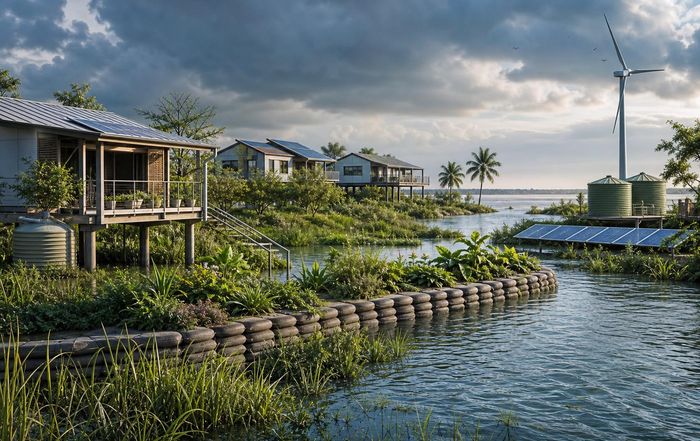
Even with improved planning, many people will continue to live in flood-prone areas for economic, cultural, or practical reasons. Strengthening buildings themselves is therefore a crucial adaptation strategy. Flood-resilient construction typically focuses on three main approaches: avoiding water entry, minimizing damage if water enters, and enabling rapid recovery. Practical measures include raising living spaces above expected flood levels, either by elevating entire structures on stilts or by placing habitable rooms on upper floors and using ground floors for parking or storage. Where elevation is not feasible, homeowners can install flood doors, barriers, or shields at entrances and windows, and ensure that walls and floors are sealed against seepage as far as possible.
Inside the home, using water-resistant materials in lower levels-such as tile instead of carpet, water-resistant insulation, and concrete or treated timber-can dramatically reduce repair costs. Electrical sockets, fuse boxes, and major appliances can be mounted higher up walls, and critical systems like boilers and heat pumps can be placed on raised platforms. Guidance from agencies such as the U.S. Federal Emergency Management Agency (FEMA) and national building councils offers detailed standards for flood-resilient design, while insurance industry bodies in various countries increasingly recognize and sometimes incentivize such measures. Communities can amplify impact by running local retrofit programs, offering technical advice, group purchasing schemes for barriers and pumps, or small grants for low-income households.
In many low- and middle-income regions, informal housing and limited resources make conventional retrofits difficult. Here, community-driven design and low-cost innovations are especially important. Simple measures like raising furniture on bricks, storing documents and valuables in waterproof containers at higher levels, using lightweight interior partitions that can be easily replaced, and designing homes with openings that allow water to flow through rather than collapse walls can save lives and livelihoods. Local NGOs, universities, and social enterprises often play a key role in co-developing context-appropriate designs, aligning with the broader themes of innovation, technology, and education that support sustainable adaptation.
Early warning systems and community preparedness
No matter how robust infrastructure and buildings become, timely warnings and well-practiced response plans remain essential. According to the World Meteorological Organization (public.wmo.int), effective early warning systems can dramatically reduce fatalities from floods and other hazards, even in low-income settings. Modern systems combine meteorological forecasts, river and tide gauges, satellite data, and, increasingly, community-based monitoring. National and regional agencies, such as the European Environment Agency (eea.europa.eu) and counterparts in Asia, Africa, and the Americas, often operate flood forecasting centers that issue alerts via official channels. However, for alerts to translate into safety, information must reach people quickly, in accessible formats, and be trusted enough to prompt action.
Community-level preparedness fills this crucial gap. Neighborhoods can establish volunteer flood wardens, create phone trees or messaging groups, and agree on clear thresholds for different actions: when to move cars, when to shift valuables upstairs, when to evacuate. Schools and workplaces can run drills and ensure that everyone knows evacuation routes and safe assembly points. Simple tools such as sirens, flags, or loudspeakers may still be the most reliable in some areas, especially where mobile coverage is patchy or electricity is unreliable. Organizations like the International Federation of Red Cross and Red Crescent Societies (ifrc.org) provide training materials and support for community-based disaster risk reduction, emphasizing the importance of including women, older people, persons with disabilities, and other often-overlooked groups in planning.
Preparedness also means having the right supplies and arrangements in place before floods strike. Households can maintain grab-bags with essential medications, documents, food, water, and clothing; local authorities can pre-identify shelters and ensure they are stocked and accessible. Agreements with nearby municipalities for mutual aid, and with local businesses for emergency logistics, can speed recovery and reduce chaos. Integrating mental health support into preparedness and response-through local health services or NGOs-can help communities cope with the psychological toll of repeated flooding, an often under-recognized aspect of personal well-being in flood-prone regions.
Financing adaptation: from household budgets to global funds
Adapting to floods costs money, and one of the hardest questions for many communities is how to pay for it. Investments range from household-level measures, such as installing flood barriers or raising electrical systems, to major public works like levees, drainage upgrades, and wetland restoration. The United Nations Framework Convention on Climate Change (UNFCCC) and related processes have spurred the creation of international climate funds, including the Green Climate Fund (greenclimate.fund), which support adaptation projects in vulnerable countries. Multilateral development banks such as the World Bank and regional banks also finance flood resilience programs, often blending grants, loans, and technical assistance. However, accessing these funds can be complex, requiring robust project proposals and governance structures that many local authorities struggle to assemble without support.
At national and local levels, governments can use a mix of public budgets, dedicated resilience funds, and regulatory tools to mobilize resources. For example, some cities impose development impact fees that help finance drainage improvements, or use land-value capture mechanisms where rising property values near new green spaces help pay for those same projects. Insurance and risk-transfer mechanisms also play a role. In some countries, public-private insurance pools spread flood risk across large populations, while in others, parametric insurance products pay out quickly based on rainfall or river levels rather than detailed damage assessments. The Organisation for Economic Co-operation and Development (OECD) and other economic bodies have highlighted the importance of aligning insurance, regulation, and public investment so that they reward risk reduction rather than perpetuating building in hazardous zones.
For households and small businesses, financing adaptation often comes down to access to affordable credit, microfinance, or targeted subsidies. Low-interest loans for resilient retrofits, tax rebates for installing green roofs or rainwater systems, and grants for low-income residents can accelerate uptake of protective measures. Local cooperatives or savings groups may pool resources to build shared infrastructure such as community-owned pumps or raised storage facilities. In all cases, transparency and community participation in funding decisions help ensure that resources reach those most in need and that projects reflect local priorities, aligning with the broader themes of sustainable business and economy.
The role of technology and data in modern flood adaptation
Digital tools are transforming how communities understand and manage flood risk. Advances in remote sensing, artificial intelligence, and open data mean that even small municipalities can access high-resolution maps and near-real-time information. Organizations like NASA (nasa.gov) and the European Space Agency (esa.int) provide satellite data that can be used to monitor rainfall, soil moisture, river levels, and land-use changes. Combined with local sensors-such as low-cost river gauges or rainfall loggers-these data streams feed into models that can forecast floods more accurately and with longer lead times. Tech companies, universities, and start-ups are increasingly offering platforms that visualize this information in user-friendly dashboards, sometimes with smartphone apps that provide tailored alerts.
At the neighborhood scale, digital mapping tools can help residents identify safe routes, vulnerable infrastructure, and potential sites for green infrastructure. Participatory mapping-where community members collect and verify data-can surface local knowledge that official maps miss, such as informal pathways, blocked drains, or frequently inundated basements. In some cities, open-source tools are used to crowdsource reports of flooding in real time, helping authorities deploy resources more effectively. These innovations align closely with our coverage of technology and innovation, illustrating how digital solutions can support practical, on-the-ground resilience.
However, technology is not a substitute for governance and social cohesion. Data must be translated into decisions, and apps are only useful if people trust them and have the means to act on warnings. There are also concerns about digital divides: marginalized communities may have less access to smartphones, internet connectivity, or the skills needed to interpret complex risk maps. To avoid widening inequalities, flood-adaptation technologies should be co-designed with users, offered in multiple languages and formats, and complemented by offline communication channels. Privacy and data protection are additional considerations when mapping households or collecting sensitive information about property and vulnerabilities.
Social equity, health, and the human side of adaptation
Floods are not only physical events; they are social and psychological shocks that can deepen existing inequalities. Low-income neighborhoods, informal settlements, and marginalized groups often occupy the most flood-prone land, with fewer savings, weaker housing, and limited access to insurance or political influence. Adaptation strategies that ignore these dynamics risk reinforcing injustice-protecting wealthier districts while leaving others exposed, or displacing communities without adequate support. Organizations such as Oxfam (oxfam.org) and academic researchers working on climate justice emphasize that fair adaptation requires meaningful participation, transparent decision-making, and explicit attention to who benefits and who bears costs.
Health impacts extend beyond immediate injuries and drownings. Floods can contaminate drinking water, spread waterborne diseases, disrupt healthcare services, and worsen chronic conditions by interrupting treatment. The World Health Organization (who.int) has highlighted the mental health consequences of repeated disasters, including anxiety, depression, and post-traumatic stress. Integrating health services into flood-preparedness plans-through vaccination campaigns, stockpiling essential medicines, and training health workers in emergency response-can reduce long-term harm. Community-based support networks, including faith groups, youth organizations, and mutual-aid initiatives, also play a crucial role in checking on vulnerable neighbors and providing informal care.
Education and public awareness are equally important. Schools can teach children about flood risks and safety measures, empowering them to act as messengers within their families. Public campaigns can explain insurance options, building-code changes, and evacuation procedures in clear, accessible language. By embedding flood adaptation into broader environmental awareness and global climate education, communities can shift from a reactive mindset to one of ongoing resilience-building. Over time, this cultural shift may be as important as any physical infrastructure, enabling societies to make difficult choices-such as relocating from the most dangerous areas-with empathy and foresight.
From reactive recovery to long-term resilience
For many flood-prone communities, the immediate priority is understandably survival and recovery from the next storm. Yet climate change is turning floods into a recurring feature rather than an occasional disaster, making it essential to move from reactive recovery to long-term resilience. That means using each flood not only as a test but as a learning opportunity: which defenses worked, which failed, who was left out of response efforts, and how can rebuilding be done smarter? Concepts like "build back better," promoted by UNDRR and others, encourage repairs and reconstruction that reduce future risk instead of simply restoring the status quo.
Practical steps might include upgrading drainage while repairing roads, elevating critical equipment during building renovations, redesigning public spaces to double as flood storage, and revising land-use plans based on observed flood extents. Businesses can incorporate flood scenarios into continuity planning, diversifying supply chains and protecting key assets. Households can gradually implement low-cost resilience measures as part of routine maintenance, rather than waiting for a major project. Collectively, these incremental actions can significantly reduce damage and disruption over time, supporting the broader goals of sustainable business, economy, and community well-being.
Ultimately, there is no single blueprint for adapting to floods. Solutions must be tailored to local geography, culture, governance, and resources, combining nature-based approaches, smart planning, resilient construction, early warning, fair financing, and social support. What unites successful efforts around the world is a shift in mindset: from viewing water solely as a threat to recognizing it as a force that must be understood, accommodated, and, where possible, harnessed. For communities willing to plan ahead, collaborate across sectors, and center equity in their decisions, living with floods can become less about constant crisis and more about deliberate, adaptive coexistence with a changing climate.
