
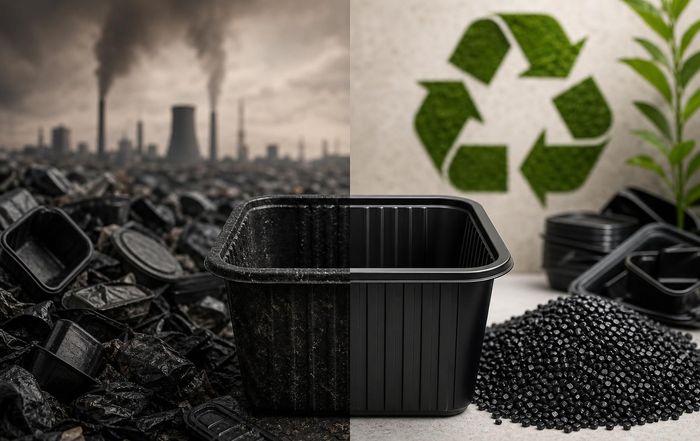
The Hidden Problem with Black Plastic Packaging - And Why It's So Hard to Recycle
Black plastic trays, lids, and film are everywhere: around supermarket ready meals, cosmetics, electronics, takeaways, and more. Yet in many regions they are among the least recycled forms of household packaging, often ending up in landfill or being burned for energy. For a material that is technically recyclable, this seems like a paradox.
Understanding why black plastic is so difficult to recycle reveals broader problems in today's packaging systems and points to practical ways consumers, businesses, and policymakers can respond.
Why Black Plastic Exists in the First Place
Black plastic did not become ubiquitous by accident. Manufacturers use it for a mix of technical, economic, and marketing reasons. The deep color can hide manufacturing defects, food stains, or recycled content, making it attractive for ready-meal trays and premium-looking consumer goods. It also helps brands create a uniform appearance across product lines, which marketers often associate with "luxury" or "sleek" design.
Historically, black plastic packaging has often been made with a high share of recycled polymers, especially mixed or lower-quality recyclate that is naturally dark. Adding black pigment masks color variations, allowing manufacturers to "downcycle" mixed plastics into a visually consistent product. That can be positive from a resource-use perspective, but it creates a serious end-of-life challenge: once plastic is turned black, it's much harder for existing sorting systems to recognize and separate it for another recycling loop.
In addition, black plastic is used across different polymer types-commonly PET, PP, and polystyrene-without clear visual distinctions. To the consumer, almost all black trays look the same, yet they can behave very differently in recycling processes. This mix of marketing needs, cost considerations, and production convenience has led to a packaging format that fits poorly into today's recycling infrastructure.
How Modern Sorting Systems Work - And Where Black Plastic Fails
Most industrial-scale recycling facilities rely on optical sorting systems to separate different plastics. A widely used technology is near-infrared (NIR) spectroscopy, which shines NIR light onto items moving along conveyor belts and reads the reflected signal to identify the type of polymer. Once identified, air jets or mechanical arms divert the item into the appropriate material stream.
The problem is that conventional black plastics are usually colored with carbon black pigments. Carbon black strongly absorbs near-infrared light instead of reflecting it. To the NIR sensor, these items appear essentially invisible or indistinguishable from one another. As a result, many facilities either mis-sort black plastic into lower-value mixed streams or reject it altogether, diverting it to landfill or energy recovery.
Organizations such as WRAP in the UK and the Ellen MacArthur Foundation have highlighted this detection issue as a major barrier to a circular economy for plastics. While some advanced sorting facilities are beginning to adopt alternative technologies-such as hyperspectral imaging, machine-vision color sorting, or modified NIR systems capable of detecting certain black formulations-these are far from universal. In many regions, the infrastructure is simply not in place to deal with black plastic at scale, even when collection systems accept it in theory.
For readers interested in how sorting and recycling systems work more broadly, our overview of plastic recycling explains the typical journey from bin to new product and the limitations at each stage.
When "Recyclable" on the Label Doesn't Match Reality
A frequent source of confusion is the gap between technical recyclability and practical recyclability. In principle, many black plastic items are made from polymers like PET or PP that can be recycled. But if the local material recovery facility (MRF) cannot detect or sort them properly, they will not be recycled in practice.
Several national and regional bodies, including the European Commission and the U.S. Environmental Protection Agency (EPA), have stressed that recyclability claims should reflect real-world systems, not just laboratory possibilities. The OECD and UN Environment Programme (UNEP) have similarly argued that misleading recyclability labels can undermine public trust in recycling and distort markets for genuinely recyclable materials.
In some markets, food brands and retailers have voluntarily phased out carbon-black trays or shifted to detectable black pigments following pressure from NGOs and consumer groups. In the UK, for example, major supermarkets worked with WRAP and the UK Plastics Pact to trial and adopt NIR-detectable black plastics or move away from black altogether. However, such changes are uneven across countries, and many products still use undetectable black pigments.
For consumers, this means that a black tray bearing a recycling symbol may still be destined for incineration, depending on local infrastructure. Checking local authority guidance, when available, is often the only way to know whether black plastic is accepted, and even then, acceptance does not always guarantee high-quality recycling.
Environmental Impacts: From Missed Recycling to Microplastics
The difficulty of recycling black plastic has several environmental consequences that extend beyond the material itself. When black packaging cannot be effectively sorted, it either contaminates recycling streams or is removed and sent to landfill or energy recovery. Both options waste the embodied energy and resources used to produce the plastic in the first place.
Landfilled plastic persists for decades or centuries, fragmenting into microplastics that can migrate into soils, waterways, and ultimately marine ecosystems. Organizations such as the United Nations Environment Programme and Greenpeace have documented how plastic leakage contributes to biodiversity loss and potential human health risks. Incineration or waste-to-energy facilities, while sometimes presented as a preferable alternative to landfill, still generate greenhouse gas emissions and, if poorly controlled, other air pollutants.
The broader climate implications are also significant. According to analyses by groups like the Ellen MacArthur Foundation and OECD, plastics production and disposal already account for a notable share of global greenhouse gas emissions, with projections rising sharply if current trends continue. Every time a recyclable polymer is lost because it cannot be sorted-black plastic included-more virgin fossil-based plastic must be produced to meet demand, locking in further emissions.
For readers exploring the climate dimension, our climate change section looks at how materials, energy, and consumption patterns shape global warming and what systemic changes are needed.
Design Choices That Lock In Waste
Black plastic packaging illustrates a broader principle: decisions made at the design stage largely determine whether a product can be recycled. This is a central concept in "design for recycling" and "design for circularity," which are gaining traction among policymakers, brands, and sustainability practitioners.
Design features that undermine recyclability include:
Use of carbon-black pigments that defeat NIR sorting.
Mixed materials, such as black plastic trays with bonded film lids or non-removable labels.
Combining incompatible polymers in a single item, making separation technically or economically unviable.
Using black simply for aesthetic reasons when clear or light-colored plastics would perform the same function.
Guidance from bodies such as Plastics Recyclers Europe, RecyClass, and similar organizations in North America and Asia encourage brands to avoid problematic colorants, reduce material complexity, and favor standardized, high-volume polymers that recyclers can process economically. These design guidelines are increasingly referenced in extended producer responsibility (EPR) schemes and eco-modulated fees, where producers pay more if their packaging is harder to recycle.
For readers interested in how businesses can respond, our new page on sustainable business explores strategies companies can adopt to align packaging design with circular-economy principles and regulatory trends.
Emerging Solutions: From Detectable Pigments to Colorless Alternatives
Despite the challenges, several promising approaches are emerging to address the specific issue of black plastic packaging.
One line of innovation focuses on detectable black pigments. Chemical companies have developed alternative colorants that appear black to the human eye but reflect enough near-infrared light to be recognized by NIR sensors. Trials reported by WRAP and others have shown that, in facilities equipped with compatible sensors, these detectable blacks can be sorted similarly to other colored plastics. Brands in Europe and elsewhere have begun to adopt these pigments, particularly for high-volume items like food trays.
Another approach is to move away from black altogether, especially for single-use, low-value items. Some retailers have switched to clear or lightly tinted PET and PP trays, which are easier to sort and have more established recycling markets. In several instances, this change has been accompanied by light-weighting, improved label design, or a shift to mono-material packaging, all of which support recyclability.
There is also growing interest in reusable packaging systems, including refillable containers, deposit-return schemes, and reusable takeaway boxes. While these systems face their own logistical and behavioral challenges, they reduce the overall volume of single-use packaging that must be collected and processed. Organizations like the Ellen MacArthur Foundation and UNEP have highlighted reuse as a critical strategy alongside recycling in global plastic pollution reduction efforts.
Finally, some pilot projects are testing digital watermarking and advanced machine-vision tools that could, in theory, identify packaging based on embedded codes or surface patterns rather than color alone. Industry collaborations such as HolyGrail 2.0 in Europe, involving major brands and packaging producers, aim to demonstrate whether such technologies can be deployed at scale.
Readers interested in the broader innovation landscape can explore our updated innovation and technology sections, which track how new tools and business models are reshaping sustainable materials and waste systems.
Policy and Market Signals: Pushing Industry Away from Problematic Formats
Policy frameworks play an increasingly important role in determining which packaging formats thrive or disappear. Across the European Union, for example, the European Commission has advanced legislation on packaging and packaging waste that emphasizes recyclability, recycled content, and waste reduction. Extended producer responsibility schemes in several EU member states and beyond are experimenting with fee structures that penalize non-recyclable or hard-to-recycle materials, including certain black plastics.
In North America, guidance from the U.S. Environmental Protection Agency and industry groups is encouraging harmonized recycling labeling and clearer design standards, while some states and provinces are exploring or implementing EPR laws for packaging. Internationally, negotiations under the proposed UN global plastics treaty, supported by UNEP, could further shape national policies on problematic packaging types.
At the same time, voluntary initiatives like the Ellen MacArthur Foundation's New Plastics Economy Global Commitment and national pacts (such as the UK Plastics Pact coordinated by WRAP) are pushing signatory companies to eliminate unnecessary or non-recyclable plastic packaging. Black plastic trays have often been singled out as a priority for phase-out or redesign because of their poor recyclability in existing systems.
These policy and market signals send a clear message to packaging designers and brand owners: formats that cannot be easily collected, sorted, and recycled at scale are increasingly out of step with regulatory expectations and consumer sentiment. For businesses, aligning with these trends is not only an environmental responsibility but also a strategic move to future-proof product lines.
Our business and economy pages look more broadly at how regulation, consumer demand, and resource constraints are reshaping markets around the world.
What Individuals Can Do in the Meantime
While systemic change is essential, individual choices still matter, especially when they send clear signals to retailers and policymakers. For households and consumers, several practical steps can reduce the impact of black plastic packaging:
Whenever possible, avoid products packaged in black plastic, especially single-use trays and pots, and choose alternatives in clear or light-colored plastic, glass, metal, or paper/cardboard where those alternatives are genuinely more sustainable. This can be particularly relevant when choosing ready meals, fresh produce, and cosmetics.
Check your local recycling guidance carefully. Many municipalities explicitly state whether they accept black plastic. If it is not accepted, placing it in the recycling bin may contaminate other materials, so it is usually better to follow local instructions even if that means disposing of it with general waste.
Where reuse options exist-such as refill shops, deposit-return containers, or bring-your-own-cup schemes-consider using them to reduce packaging demand entirely. Our daily sustainable living and lifestyle pages provide more ideas on integrating low-waste habits into daily routines.
Engaging with retailers and brands can also be effective. Customer feedback, whether in-store, online, or via social media, has helped accelerate the phase-out of problematic packaging in several markets. When consumers ask why a product still comes in undetectable black plastic and express a preference for recyclable or reusable formats, companies notice.
Finally, supporting organizations and policies that push for clearer design standards, stronger EPR schemes, and improved recycling infrastructure helps tackle the root causes rather than just the symptoms. Groups such as Greenpeace, OECD, UNEP, and national NGOs campaign and provide analysis on how waste systems can be redesigned to prevent pollution and support a circular economy.
For clever readers wanting to understand waste issues more broadly, our page on waste offers additional context on how materials flow through economies and where interventions can have the greatest impact.
Rethinking Color in a Circular Economy
The story of black plastic packaging is ultimately a story about design choices and system boundaries. A color that works well for branding, hides imperfections, and accommodates recycled content becomes a liability when it cannot be detected by common sorting technologies. The result is a material that is technically recyclable on paper but often unrecyclable in practice.
As governments tighten regulations, companies commit to circular-economy targets, and new technologies emerge, the role of black plastic is likely to shrink or change significantly. Detectable pigments and advanced sorting may keep some forms of black packaging in circulation, especially in closed-loop or high-value applications. But for many single-use items, the most sustainable choice may be to eliminate black altogether or redesign products around reuse and simpler, more recyclable materials.
For individuals, the challenge of recycling black plastic is a reminder that sustainability is not just about what goes into the bin, but about the upstream decisions that shape what ends up in our hands in the first place. By combining smarter design, better policy, and more informed consumer choices, it is possible to move beyond packaging formats that look good on the shelf but fail the test of a truly circular system.
