
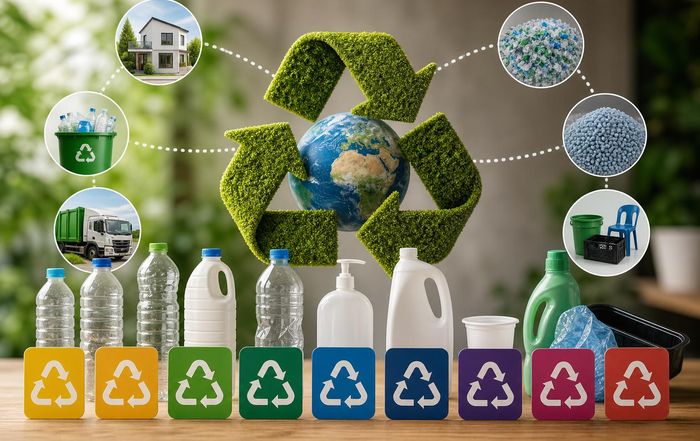
What Plastic Recycling Symbols Actually Mean for Households
The little triangle on plastic packaging looks reassuring, but it is also deeply misunderstood. Many households assume that any package with a recycling symbol will be recycled if it goes into the bin. In reality, those symbols mostly describe what type of plastic an item is made from, not whether local facilities will accept it. Understanding the difference is essential for anyone trying to reduce waste, live more sustainably, and avoid "wishcycling" - putting non-recyclable items into the recycling bin and hoping for the best.
This guide unpacks what the main plastic symbols mean, how they relate to real-world recycling, and how households can use them to make better choices, not just better-sorted bins.
For broader context on everyday environmental choices, you may also find our updated pages on sustainable living, plastic recycling, and waste useful companions to this awesome article.
The two very different "recycling" symbols on plastics
Before diving into the numbers, it helps to distinguish between two types of symbols that often get confused.
The first is the Resin Identification Code (RIC) - the number inside a triangle of arrows, usually 1 to 7. This system was originally developed by the Society of the Plastics Industry (now PLASTICS) in the late 1980s to help sort different plastic resins. It was never meant as a promise that an item would be accepted in curbside recycling. In many countries the design has since been updated (for example, replacing chasing arrows with a triangle) to reduce confusion, but a lot of packaging still uses the familiar arrows.
The second is a recycling or collection label that indicates how to dispose of the packaging in a particular country or region. In the UK, for instance, the On-Pack Recycling Label (OPRL) scheme uses phrases like "Recycle," "Don't Recycle," or "Recycle with bags at larger stores." In the US and many other countries, local governments publish their own guidance. These labels, not the resin code, are what households should follow when deciding whether something goes in the recycling bin, the trash, or a return-to-store collection.
Because recycling rules differ significantly between cities and countries, organizations such as the US Environmental Protection Agency (EPA), the European Commission (ec.europa.eu), and national environment agencies stress that residents should always check local guidance. The resin code is just one piece of information, and often a misleading one if taken alone.
Why the numbers 1-7 exist - and what they do not guarantee
The resin codes group plastics into seven broad families based on their polymer chemistry. From a technical standpoint, this helps recycling facilities and manufacturers understand what material they are dealing with. From a household standpoint, the numbers are a rough guide to how likely something is to be recyclable in practice - but that likelihood depends heavily on local infrastructure, contamination, and market demand.
Globally, plastic recycling rates remain low. Estimates compiled by the Organisation for Economic Co-operation and Development (OECD) suggest that only around 9% of plastic waste is recycled, with the majority landfilled, incinerated, or leaking into the environment. Even in regions with more advanced infrastructure, like the EU or some US cities, not every plastic with a triangle is actually recycled. Complex packaging, food contamination, dark pigments, and economic factors can all make technically recyclable plastics effectively non-recyclable.
For households, the key is to treat the numbers as material labels rather than recycling promises. They can help you avoid certain plastics when shopping, understand which items are more likely to be recycled where you live, and recognize when a product is using multi-layer or mixed materials that will probably end up as waste.
#1 PET (or PETE): Bottles that often are recycled - with caveats
Polyethylene terephthalate (PET), code #1, is one of the most widely used and widely recycled plastics. It is commonly found in:
Soft drink and water bottles
Some cooking oil and juice bottles
Many clear food containers and clamshells
Because PET is in high demand for making recycled polyester fibers and new bottles, it is a core material in many municipal recycling programs across North America, Europe, and parts of Asia. Organizations such as Plastics Recyclers Europe (plasticsrecyclers.eu) and the Association of Plastic Recyclers (plasticsrecycling.org) identify PET bottles as a key feedstock for the recycling industry.
However, even with PET there are important household considerations. Bottles are usually accepted; PET trays and clamshells may not be, depending on your local facility. Darkly colored PET and items with full shrink-sleeve labels or complex multi-material structures can be harder to sort and recycle. Food contamination - for example, oily residues or leftover salad - also reduces the likelihood that an item will make it through the process.
From a sustainable living perspective, the presence of a #1 symbol means a relatively high chance of recyclability in many regions, but it still makes sense to prioritize reuse (refillable bottles, tap water, or bulk purchase) over single-use PET. Readers interested in the broader climate and resource implications of packaging choices may find our climate change and global sections helpful for wider context.
#2 HDPE: A strong candidate for genuine recycling
High-density polyethylene (HDPE), code #2, is another plastic that is widely collected and recycled in many countries. It is used in:
Milk and juice jugs
Shampoo and detergent bottles
Some cleaning product containers
Sturdy carrier bags and crates
HDPE is valued for its strength and chemical resistance, and it can be recycled into new bottles, pipes, plastic lumber, and a range of durable products. Many curbside programs in countries like the US, UK, Germany, and Australia explicitly list HDPE bottles and jugs as acceptable, especially when they are rigid, opaque, and have simple labels.
Yet again, not every #2 item will be recycled. Flexible HDPE films and bags may require separate collection systems, such as store drop-off points, and many communities lack these. Colored or multi-layer HDPE packaging can also be more challenging to process. Households are usually advised by local authorities or organizations like WRAP in the UK (wrap.org.uk) to rinse containers, replace caps if requested (some systems prefer them on, others off), and avoid placing flexible films into bins that only accept rigid plastics.
When choosing between products, #2 HDPE bottles and jugs are generally among the better options from a recyclability perspective, especially compared with multi-layer pouches or composite cartons that may be harder to recycle in practice.
#3 PVC: The problem plastic that rarely belongs in household recycling
Polyvinyl chloride (PVC), code #3, is a versatile but controversial plastic used in:
Pipes and building materials
Some shrink wrap and blister packs
Certain clear food packaging
Medical tubing and equipment
PVC contains chlorine and often a range of additives. When heated or burned, it can release harmful substances, which is why environmental organizations such as Greenpeace (greenpeace.org) and many public health advocates have long raised concerns about its lifecycle impacts. From a recycling standpoint, PVC is problematic because it can contaminate batches of other plastics like PET if it slips through sorting systems.
Most household recycling programs do not accept PVC packaging or products in curbside bins. In many places, PVC should be placed in general waste, or in some cases taken to specialized construction and demolition waste facilities. Medical PVC, such as IV bags and tubing, may be collected through dedicated hospital schemes in some countries, but this is separate from household recycling.
For households aiming to reduce waste and exposure to problematic chemicals, the #3 symbol is usually a red flag rather than an invitation to recycle. Choosing products packaged in #1 or #2 plastics, or in non-plastic materials like glass or metal, is often a more sustainable option when available.
#4 LDPE: Films, bags, and the challenge of flexible plastics
Low-density polyethylene (LDPE), code #4, is commonly used in:
Plastic bags and bin liners
Bread bags and frozen food bags
Squeezable bottles and tube heads
Some cling film and bubble wrap
LDPE films and flexible packaging are technically recyclable, but they present major challenges in many recycling systems. Thin films can tangle in sorting equipment, are easily contaminated with food residues, and are less valuable on the secondary materials market than rigid plastics. As a result, many curbside programs around the world either do not accept plastic films at all or only accept them through separate collection streams.
In some countries, supermarkets and retailers run take-back or drop-off schemes for plastic bags and certain films, often in partnership with recycling companies. Organizations like The Recycling Partnership in the US (recyclingpartnership.org) and various industry coalitions are working to improve collection and processing of flexible plastics, but coverage remains patchy.
For households, the practical meaning of a #4 symbol is often: "This might be recyclable somewhere, but probably not in your regular bin." The most sustainable strategy is usually to avoid single-use films and bags, opt for reusable cloth bags and containers, and look for products with minimal or recyclable rigid packaging. When local drop-off options do exist, residents should follow the specific instructions about what types of film are accepted and how clean they must be.
#5 PP: Growing recyclability, but still inconsistent
Polypropylene (PP), code #5, is used in a wide range of household items, including:
Yogurt pots and margarine tubs
Takeaway food containers
Bottle caps and straws
Microwaveable meal trays
Some reusable food containers
PP has historically been less commonly recycled than PET and HDPE, but this is changing. Demand for recycled PP is growing, and more sorting technologies can now identify and separate it. Industry groups like the Polypropylene Recycling Coalition (supported by The Recycling Partnership) are working to expand PP collection in the US, while European initiatives are also increasing the number of programs accepting PP packaging.
Despite this progress, recyclability remains inconsistent. Some cities and regions accept PP tubs and lids in curbside bins; others do not, or only accept certain shapes and colors. Black PP, for example, can be hard for optical sorters to detect. Multi-material items, such as coffee cups with PP lids and paper sleeves, may be technically recyclable in parts but not as a whole product.
Households can treat #5 as a "maybe recyclable" code and should check local guidance carefully. When comparing products, choosing simpler PP packaging over complex, multi-layer pouches can improve the chances that at least some of the material will be recovered. But, as with all plastics, reducing single-use consumption and reusing containers where feasible usually has a greater environmental benefit than relying on recycling alone.
#6 PS: Why polystyrene is rarely a good bet
Polystyrene (PS), code #6, appears in two main forms:
Rigid PS, used in some disposable cutlery, CD cases, and small appliances
Expanded polystyrene (EPS or "Styrofoam"), used for takeaway boxes, cups, and protective packaging
While polystyrene is technically recyclable, the reality for households is that very few curbside programs accept it. EPS in particular is bulky, lightweight, easily contaminated with food, and uneconomical to transport and process. Many local authorities and national environment agencies, including bodies like the UK Environment Agency (gov.uk) and similar regulators elsewhere, advise residents to place polystyrene food packaging in general waste.
Some specialized facilities can compact and recycle EPS, and certain electronics retailers or packaging suppliers run take-back schemes for clean protective foam. These are, however, niche options rather than mainstream household solutions. For everyday decisions, the #6 symbol is best read as: "This is almost certainly not going to be recycled."
From a sustainable lifestyle perspective, avoiding polystyrene where alternatives exist is one of the clearest ways to reduce hard-to-manage plastic waste. Choosing reusable coffee cups, durable containers, or cardboard-based protective packaging can significantly cut down on this problematic material. Our lifestyle and design sections explore many such alternatives.
#7 "Other": The catch-all category for complex plastics
Code #7, often labeled "Other," covers all plastics that do not fit into the first six categories. This includes:
Polycarbonate (PC), used in some water jugs and older reusable bottles
Bioplastics like PLA (polylactic acid) used in some compostable cups and packaging
Multi-layer and mixed plastics designed for barriers or special properties
Because #7 is a catch-all, it tells households almost nothing about recyclability. Many #7 items are not accepted in curbside programs. Some bioplastics are designed for industrial composting, not recycling, and may require specific collection systems or facilities to break down properly. Organizations such as the US Composting Council (compostingcouncil.org) and certification bodies like TÜV Austria or BPI provide standards for what counts as compostable under industrial conditions, which are very different from home compost heaps.
For households, the practical meaning of #7 is often: "Treat this as non-recyclable unless your local authority explicitly says otherwise." The presence of green coloring, leaves, or "eco" branding does not guarantee that an item will compost safely in a backyard bin or be accepted in industrial systems. In many communities, #7 packaging - including bioplastics - ends up in general waste or incineration.
When sustainable options are available, choosing packaging clearly labeled as widely recyclable (#1 or #2 bottles, for example) or genuinely reusable is usually more reliable than relying on ambiguous #7 items with marketing-driven claims.
The problem of "wishcycling" - and how to avoid it
"Wishcycling" occurs when people put items into the recycling bin because they hope they are recyclable, even when guidance suggests otherwise. This well-intentioned behavior can cause significant problems. Contaminated or unsuitable materials can clog machinery, lower the quality of recyclable bales, and increase costs for recycling operators. In some cases, entire batches of otherwise recyclable material may be landfilled or incinerated because contamination levels are too high.
Environmental agencies such as the US EPA, Environment and Climate Change Canada (ec.gc.ca), and local authorities across Europe and Asia repeatedly emphasize that following local instructions is more important than guessing based on symbols. If your city says "no plastic bags" in the recycling bin, putting #4 LDPE bags in the bin anyway is likely to do more harm than good. Similarly, if your council only accepts bottles and jugs, adding yogurt pots or clamshells may contaminate the stream.
To avoid wishcycling, households can:
Check their municipality's website or printed guides at least once a year, as rules can change.
Keep a small list or poster near the bin summarizing what is and isn't accepted.
Treat ambiguous items - especially films, pouches, and mixed materials - as general waste unless clearly accepted.
Remember that clean, simple, and rigid plastics (especially #1 and #2 bottles) are more likely to be genuinely recycled than complex forms.
Our environmental awareness and education sections explore how better information and habits can make household recycling more effective and less confusing.
Beyond the triangle: other plastic and recycling labels to know
Alongside resin codes, households increasingly encounter other symbols and labels on packaging:
Mobius loop (three arrows forming a triangle without a number): Indicates that the item is recyclable in principle, not necessarily that it is accepted locally.
Percentage recycled content: Tells you how much of the material is made from recycled inputs; this is about production, not end-of-life.
Deposit return symbols: Indicate that a container is part of a bottle deposit scheme. These are common in countries with deposit-refund systems, where returning bottles to a machine or store is often the most effective way to ensure high-quality recycling.
Compostable or biodegradable labels: These are particularly confusing. "Biodegradable" is often loosely used and may not correspond to any robust standard. "Compostable" may refer to industrial composting conditions, not home compost. Reputable certifications usually reference specific standards (such as EN 13432 in Europe) and may include recognizable logos from accredited bodies.
In practice, the most trustworthy disposal guidance for households tends to come from local government or recognized national schemes, rather than marketing claims on the packaging itself. Checking local rules may feel like an extra step, but it can prevent good intentions from backfiring.
What these symbols mean for sustainable living choices
Understanding plastic symbols is useful, but it is only one part of a larger shift toward more sustainable lifestyles. For many households, the most impactful actions are not about sorting more types of plastic into the right bin, but about generating less plastic waste in the first place.
From a sustainable living perspective, the codes can guide better purchasing decisions:
Prefer products in widely recycled materials such as #1 and #2 bottles, aluminum cans, or glass jars where practical.
Be cautious about products packaged in #3, #6, or #7 plastics, which are often hard to recycle or environmentally problematic.
Recognize that flexible films and multi-layer pouches (often #4 or #7) are rarely recycled in household systems, even if they carry a triangle.
Support brands and retailers that design packaging with clear, honest disposal instructions and that participate in take-back, refill, or deposit schemes.
At the same time, focusing on reuse, repair, and reduction can often deliver bigger environmental benefits than marginal improvements in recycling. Refillable water bottles, bulk food purchasing, reusable shopping bags, and durable storage containers can all reduce the volume of single-use plastics entering your home. Our key pages on sustainable business and personal well-being explore how these choices intersect with health, convenience, and broader economic shifts.
Making the symbols work for you - not the other way around
For households trying to "do the right thing," plastic recycling symbols can feel like a maze of numbers, arrows, and eco-sounding claims. The key is to reframe their role. The resin codes (1-7) are not promises; they are labels that tell you what kind of plastic you are dealing with and, indirectly, how likely it is to be recyclable where you live. Actual recyclability depends on local infrastructure, contamination, and market demand, which is why guidance from local authorities and organizations like the EPA, European Commission, and national environment agencies remains essential.
In practical terms, households can use the symbols to:
Recognize which plastics to prefer when alternatives are limited (often #1 and #2 bottles and jugs).
Identify plastics to avoid when possible (#3, #6, many #7 items, and complex films and pouches).
Realize when "recyclable" on the pack is more of a technical statement than a real-world likelihood.
Make more informed choices that align with broader goals around innovation and technology, economy, and environmental protection.
Ultimately, plastic symbols are only tools. The most meaningful progress comes when households, communities, businesses, and policymakers work together to reduce unnecessary plastic use, design packaging that is genuinely recyclable or reusable, and build systems that actually deliver on the promises printed on our products.
