
How Schools Can Encourage Sustainable Living Habits
The Strategic Role of Schools in a World Under Pressure
Has anybody else noticed or is it just me? As climate risks intensify and social expectations on environmental responsibility grow, schools have moved to the center of the global sustainability conversation. Education systems now shape not only academic outcomes but also the daily habits, values, and long-term decision-making of the next generation of citizens, consumers, and leaders. For YouSaveOurWorld, which focuses on empowering individuals and organizations to embrace sustainable living, the question is no longer whether schools should encourage sustainable living habits, but how they can do so in ways that are credible, evidence-based, and scalable.
Across continents, educators, policymakers, and business leaders increasingly recognize that the classroom is a powerful catalyst for behavioral change, and that the formative years of childhood and adolescence provide a uniquely effective window to embed environmentally responsible routines. Research from organizations such as the UNESCO-backed Education for Sustainable Development initiative underscores that when sustainability is integrated into school culture, curriculum, and community partnerships, students are significantly more likely to adopt pro-environmental behaviors that persist into adulthood. In this context, understanding how schools can systematically foster sustainable living habits is both a moral imperative and a strategic investment in long-term social resilience and economic stability.
Building Environmental Literacy as a Foundation for Action
Any meaningful effort to embed sustainable habits begins with environmental literacy. Students must understand the science, systems, and social dynamics behind the environmental challenges they are asked to help solve. High-quality resources from institutions such as the Intergovernmental Panel on Climate Change (IPCC), accessible through IPCC climate reports, provide evidence-based material that teachers can translate into age-appropriate lessons, helping learners connect abstract concepts like greenhouse gas emissions, biodiversity loss, and resource depletion to their own lives.
However, literacy must extend beyond climate science to encompass broader ecological and social systems. When schools encourage students to engage with resources on climate change impacts, they begin to see how energy choices, food systems, transportation, and waste management interact with economic and health outcomes. Platforms such as the United Nations Environment Programme (UNEP), which offers accessible overviews of global environmental trends, allow educators to ground classroom discussions in globally recognized data and frameworks while still connecting these macro-level issues to local realities.
For YouSaveOurWorld.com, which highlights environmental awareness as a core theme, this literacy dimension is essential. Without a clear understanding of why sustainable living matters and how individual actions fit into a wider system, behavior change efforts risk becoming superficial or short-lived. Environmental literacy gives students the cognitive tools to evaluate trade-offs, question unsustainable norms, and make informed decisions in both their personal and professional futures.
Integrating Sustainable Living into the Curriculum
To move from awareness to habit formation, schools must embed sustainability across disciplines rather than confining it to a single science or civics unit. When sustainability is treated as an interdisciplinary theme, students encounter it repeatedly, in different contexts and through multiple lenses, which strengthens both understanding and behavioral reinforcement.
In science classes, students can investigate energy efficiency, renewable technologies, and ecological cycles using data from organizations such as the International Energy Agency (IEA), whose energy and emissions statistics help connect classroom experiments to real-world policy and industry trends. In mathematics, learners can model carbon footprints or analyze waste reduction metrics, developing quantitative skills while internalizing the measurable impact of lifestyle choices. In language and social studies courses, they can examine narratives around environmental justice, indigenous stewardship, and the social dimensions of resource use, guided by frameworks such as the United Nations Sustainable Development Goals (SDGs), accessible through UN SDG resources.
This cross-curricular integration aligns closely with the holistic approach promoted on YouSaveOurWorld.com, where sustainability intersects with business, global issues, and education. By weaving environmental themes through subjects that students perceive as directly relevant to their future careers-economics, entrepreneurship, technology, and design-schools can demonstrate that sustainable living is not a peripheral concern but a core competency for 21st-century success.
Cultivating Sustainable Habits Through Daily School Operations
Curriculum alone cannot transform habits; students learn as much from what schools do as from what they say. When the physical environment and operational practices of a school visibly reflect sustainable principles, those principles become normalized, tangible, and practical. This is where the operational side of education intersects with the themes of sustainable living and waste that are central to YouSaveOurWorld.com.
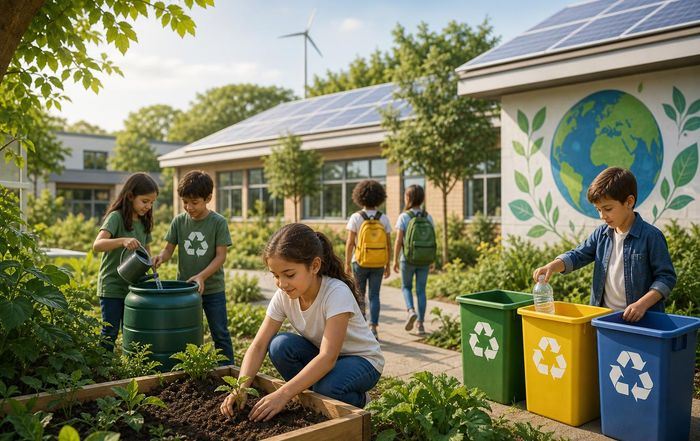
Simple, consistent practices-such as clearly labeled recycling and composting stations, energy-efficient lighting, and water-saving fixtures-offer daily, low-friction opportunities for students to act sustainably. Guidance from bodies like the U.S. Environmental Protection Agency (EPA), available through its sustainable management of materials resources, can support school administrators in designing waste and resource management systems that are both effective and educational. When students see their school tracking energy use, reporting waste reduction results, and celebrating milestones, they begin to associate sustainability with measurable progress and collective achievement.
Moreover, schools can integrate sustainable procurement policies, choosing suppliers who prioritize environmental performance and transparency. Standards and frameworks from organizations such as the World Resources Institute (WRI), whose corporate sustainability tools are widely used in the private sector, can be adapted for educational institutions, signaling to students that responsible sourcing is a professional norm they should expect in their future workplaces as well.
Plastic Recycling as a Visible Entry Point for Behavior Change
Among the many dimensions of sustainable living, plastic use and waste offer one of the most visible and relatable entry points for students. The ubiquity of single-use plastics in school cafeterias, vending machines, and events provides an immediate, concrete opportunity for both education and action. For a platform like YouSaveOurWorld.com, which dedicates specific attention to plastic recycling, schools represent a critical arena where theory can translate into tangible habit formation.
To foster responsible plastic use, schools can implement structured recycling programs supported by clear signage, regular communication, and student-led monitoring. Resources from the Ellen MacArthur Foundation, which promotes the circular economy, help educators and administrators learn more about circular economy principles that go beyond simple recycling to address product design, reuse, and material loops. When students are involved in auditing plastic use, redesigning packaging choices, and presenting findings to school leadership, they gain both practical recycling skills and a systems-level understanding of why upstream reduction is often more impactful than downstream processing.
Furthermore, linking plastic initiatives to broader discussions about ocean health, microplastics, and human well-being-drawing on evidence from organizations like The Ocean Cleanup, which shares data and insights on plastic pollution in oceans-helps students see that each bottle or wrapper represents part of a global challenge. Over time, this connection encourages them to internalize low-plastic habits in their homes, communities, and eventual workplaces, creating a multiplier effect that extends far beyond the school campus.
Embedding Sustainability into School Culture and Identity
For sustainable living habits to endure, they must become part of a school's identity rather than a temporary project or campaign. Culture is built through rituals, narratives, leadership behaviors, and peer norms, and in the sustainability context, these elements can be intentionally shaped to reinforce pro-environmental habits. This cultural dimension aligns with the broader lifestyle focus of YouSaveOurWorld.com, which explores how lifestyle choices intersect with environmental and social outcomes.
Leadership is crucial. When school administrators, board members, and senior teachers publicly commit to sustainability goals, report progress, and participate in sustainable behaviors themselves-cycling to school, reducing meat consumption in cafeterias, or minimizing single-use plastics-they signal that sustainability is not merely a student responsibility. Guidance from the World Economic Forum (WEF) on sustainability and education can help leaders frame these commitments within broader economic and societal transitions, linking school culture to global conversations about resilience and competitiveness.
Student voice is equally important. When learners are given structured opportunities to shape sustainability policies, lead campaigns, and design projects, they internalize a sense of agency and ownership. Over time, these experiences cultivate leadership skills that extend well beyond environmental issues, preparing students to influence corporate cultures and public policies later in life. As these former students move into the workforce, they carry with them the expectation that organizations-from startups to multinational corporations-should demonstrate the same level of environmental accountability they experienced in school.
Connecting Sustainability to Business, Economy, and Future Careers
One of the most effective ways to motivate adolescents to adopt sustainable habits is to connect those habits to their aspirations for meaningful careers and financial stability. On YouSaveOurWorld.com, sustainability is explicitly linked to business, economy, and innovation, reflecting the reality that environmental responsibility is now a core driver of competitive advantage and risk management in the corporate world.
Schools can draw on materials from organizations such as the World Business Council for Sustainable Development (WBCSD), which showcases how leading companies integrate sustainability into strategy and operations, to help students learn more about sustainable business practices. By examining real-world case studies-from renewable energy investments to circular product design-students see that sustainable habits are not only ethically desirable but economically rational, shaping their expectations of employers and their own entrepreneurial ventures.
Career guidance programs can further reinforce this connection by highlighting emerging roles in green finance, sustainable supply chain management, environmental data science, and clean technology. Resources from the International Labour Organization (ILO) on green jobs and skills provide evidence that sustainability-related competencies are in growing demand across sectors. When students understand that their sustainable living habits-energy conservation, responsible consumption, waste reduction-mirror the professional skills valued in the future labor market, they are more likely to internalize these behaviors as part of their personal brand and long-term career strategy.
Harnessing Technology and Innovation in the Classroom
Digital tools and emerging technologies offer powerful avenues for making sustainable living both engaging and measurable. For a platform like YouSaveOurWorld.com, which emphasizes innovation and technology, the intersection of edtech and sustainability is a particularly promising frontier.
Schools can use data dashboards to track energy use, water consumption, and waste generation in real time, turning the entire campus into a living laboratory. Platforms and sensors inspired by smart-city technologies allow students to analyze trends, propose interventions, and evaluate outcomes. Guidance from the International Telecommunication Union (ITU) on ICTs and sustainability can help educators frame these projects within the broader context of digital transformation and climate resilience.
Virtual labs, simulations, and augmented reality experiences can immerse students in complex environmental systems that would be impossible to replicate physically, from coral reef ecosystems to global supply chains. At the same time, schools must encourage critical reflection on the environmental footprint of digital technologies themselves, drawing on research from organizations such as The Shift Project, which explores the energy impact of digital technology. This dual focus-leveraging technology for sustainability while acknowledging and mitigating its own impacts-helps students develop nuanced, systems-level thinking that will be essential in their future professional roles.
Linking Sustainable Habits to Health and Personal Well-Being
Sustainable living is not only about protecting ecosystems and stabilizing the climate; it is also deeply intertwined with human health and quality of life. By explicitly linking environmental habits to personal well-being, schools can tap into powerful intrinsic motivations that often resonate more strongly than abstract planetary concerns, particularly among younger students.
Active transport initiatives-such as walking or cycling to school-simultaneously reduce emissions and improve physical health, and guidelines from the World Health Organization (WHO) on physical activity and health can help schools design programs that are safe, inclusive, and evidence-based. Similarly, school gardens and plant-based menu options introduce students to sustainable food systems while improving nutritional outcomes, with support from resources such as the Food and Agriculture Organization (FAO), which offers insights on sustainable diets and agriculture.
When schools frame sustainable choices-such as reducing processed food consumption, spending more time outdoors, or limiting unnecessary consumption of goods-as pathways to lower stress, better mental health, and stronger social connections, students begin to see environmental responsibility not as a sacrifice but as an enhancement of their daily lives. This alignment between planetary health and personal well-being reinforces habits that are more likely to persist through the transitions of adolescence, higher education, and entry into the workforce.
Designing Learning Environments that Model Sustainability
The physical design of school buildings and campuses has a profound influence on both environmental performance and student behavior. Architectural choices that prioritize natural light, efficient insulation, renewable energy, and low-impact materials not only reduce operational costs and emissions but also serve as daily, visible demonstrations of sustainable principles in action. On YouSaveOurWorld.com, where design is recognized as a strategic lever for sustainability, this connection between built environment and learning is particularly salient.
Guidelines from organizations such as the U.S. Green Building Council (USGBC), which oversees the LEED green building certification, can inform school construction and renovation projects that aim to balance performance, aesthetics, and educational value. When students see solar panels on roofs, green spaces integrated into courtyards, and classrooms designed for natural ventilation, they internalize the idea that sustainability is a design challenge that can be solved creatively rather than a constraint to be reluctantly managed.
Moreover, involving students in the planning and evaluation of these spaces-through design charrettes, feedback sessions, or project-based learning-helps them understand the trade-offs and complexities involved in real-world sustainability decisions. This exposure prepares them to engage with similar challenges in future roles in architecture, urban planning, engineering, or corporate real estate, reinforcing the idea that sustainable living habits are inseparable from the physical and organizational systems that shape daily life.
Partnering with Families, Communities, and Businesses
Schools cannot cultivate sustainable living habits in isolation; they must operate as hubs within broader ecosystems of families, community organizations, and businesses. When messages and practices are reinforced across home, school, and community environments, behavior change is more likely to be durable and far-reaching. This systems perspective aligns strongly with the integrated approach of YouSaveOurWorld.com, which emphasizes the interplay between global trends, local action, and individual responsibility.
Partnerships with local businesses that prioritize sustainability-such as renewable energy providers, circular economy startups, or socially responsible retailers-can provide students with real-world role models and internship opportunities. Resources from the OECD on education-business collaboration can guide schools in structuring these partnerships to maximize educational value while maintaining independence and integrity. At the same time, community organizations, NGOs, and local governments can support school-led initiatives through joint campaigns, shared resources, and public recognition.
Engaging families is equally important. Workshops, newsletters, and community events that share practical tips on energy conservation, waste reduction, and sustainable consumption help parents and caregivers align household practices with school messages. When students see their sustainable habits-such as recycling, reducing food waste, or choosing low-impact products-mirrored and reinforced at home, those habits become part of their identity rather than simply a set of school rules.
A Top Agenda for Schools and for YouSaveOurWorld
Yet today the imperative for schools to encourage sustainable living habits is no longer a matter of ethical aspiration alone; it is a strategic necessity aligned with global economic trends, labor market dynamics, and societal expectations. The institutions that successfully embed sustainability into their curricula, operations, culture, and community partnerships will not only reduce their own environmental footprints but also equip their students with the competencies, values, and habits needed to thrive in a rapidly changing world.
For YouSaveOurWorld.com, this landscape presents both a responsibility and an opportunity. By curating practical and completely original guidance on sustainable living, sustainable business, technology, and education, and by connecting these themes to the everyday realities of schools, families, and communities, the platform can help bridge the gap between high-level sustainability discourse and the concrete habits that are formed in classrooms and corridors.
Ultimately, the transformation of schools into engines of sustainable living is not a peripheral project but a central pillar of any credible strategy to address climate change, resource constraints, and social inequality. By aligning environmental literacy with operational practice, linking sustainable habits to health and economic opportunity, and leveraging design and technology to model new ways of living, schools can help ensure that the next generation does not merely inherit the challenges of the 21st century but is equipped-and motivated-to solve them.
