
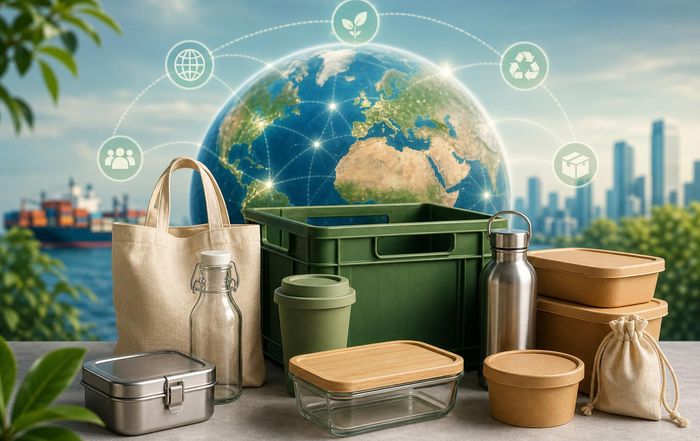
The Future of Reusable Packaging in Global Markets!!
Reusable Packaging at a Global Turning Point
Reusable packaging has moved from the margins of sustainability discourse into the center of global business strategy, regulatory reform, and consumer expectation. What was once dismissed as a niche concept associated with small zero-waste stores or local refill schemes is now being evaluated in boardrooms of multinational corporations, debated in national parliaments, and embedded into the design of new urban infrastructure. For YouSaveOurWorld which has long focused on connecting sustainable living, responsible business, and personal well-being, reusable packaging represents a critical intersection where environmental necessity, economic opportunity, and technological innovation converge.
The shift is being driven by a confluence of forces: escalating public concern about plastic pollution, rising waste management costs, tightening regulations on single-use materials, and a growing body of evidence showing that circular systems can outperform linear models when they are designed and managed correctly. Organizations such as the Ellen MacArthur Foundation have demonstrated how circular economy principles can dramatically reduce waste and emissions, while still enabling growth and innovation, and their work has become a reference point for companies exploring reusable solutions. Learn more about the wider implications of a circular economy for packaging.
At the same time, there is a growing recognition that reusable packaging is not simply a technical fix; it is a systemic transformation that touches logistics, consumer behavior, digital technology, business models, and public policy. This aligns closely with the integrated perspective each day that YouSaveOurWorld brings to topics such as sustainable living, waste reduction, and sustainable business, where environmental outcomes are inseparable from economic resilience and human well-being.
From Linear to Circular: Why Reuse Is Rising Now
The traditional packaging model has been profoundly linear: resources are extracted, converted into packaging, used once, and then discarded, often ending up in landfills, incinerators, or the natural environment. This approach has created a global waste crisis, with the OECD estimating that plastic waste generation has more than doubled over the past two decades, while recycling has failed to keep pace. Readers can explore the global waste trends and their economic consequences through the OECD's work on global plastics outlook.
Recycling, although essential, has proven insufficient on its own. Contamination, limited infrastructure, fluctuating commodity prices, and design challenges have all constrained its effectiveness. Many businesses and policymakers now see reuse as an indispensable complement to recycling, particularly for high-volume packaging formats such as beverage containers, food service packaging, e-commerce parcels, and household product bottles. For those following developments in plastic recycling, the conversation has evolved from "How do we recycle more?" to "How do we prevent waste from being created in the first place?"
Regulators have accelerated this shift. The European Union, through its Circular Economy Action Plan and the Packaging and Packaging Waste Regulation, has introduced binding reuse targets for certain sectors, while also restricting unnecessary single-use items. Businesses operating in European markets are now required to consider reuse not as an optional pilot, but as a compliance issue and a competitive differentiator. More detailed information on these regulatory changes is available from the European Commission's resources on circular economy and packaging.
Similar dynamics are emerging in other regions. In North America, extended producer responsibility schemes are gaining traction at state and provincial levels, while in Asia, governments are grappling with the dual challenges of rapid urbanization and growing waste streams. Organizations such as the World Bank have highlighted the economic and public health costs of unmanaged waste, particularly in fast-growing cities, underlining the need for new models of packaging and consumption. Those interested in the global perspective on solid waste can review the World Bank's work on waste management and development.
For businesses that follow YouSaveOurWorld.com for insights on global sustainability trends and climate change, reusable packaging is emerging as a strategic lever to reduce emissions, improve resource efficiency, and build resilience in supply chains that are increasingly exposed to regulatory, reputational, and climate-related risks.
Business Models Powering the Reuse Revolution
The future of reusable packaging will not be defined by materials alone, but by the business models that orchestrate flows of products, data, and value. Several archetypes are now visible across global markets, each with its own operational challenges and strategic implications.
One prominent model is the deposit-return system, long associated with refillable beverage containers in countries such as Germany and the Nordics, but now being reimagined with digital tools and expanded to new categories. Consumers pay a small deposit when they purchase a product in reusable packaging, which is refunded when the packaging is returned to a collection point or through a reverse logistics system. This approach has been supported by organizations such as Ellen MacArthur Foundation and is increasingly embedded into national legislation. Businesses can examine how deposit-return systems improve collection rates and material quality by reviewing resources from the European Environment Agency on waste prevention and reuse.
Another emerging model is packaging-as-a-service, where the ownership of packaging remains with a specialized operator or brand, and customers effectively rent the packaging for the duration of its use. This approach is being tested in e-commerce, food delivery, and retail environments, often supported by digital tracking, cleaning networks, and standardized formats. For companies exploring innovation in business models, packaging-as-a-service demonstrates how recurring revenue streams and asset utilization can be improved while reducing waste.
Refill-at-home and refill-on-the-go models are also growing, where consumers purchase concentrates or bulk products and use durable containers repeatedly. Large consumer goods companies such as Unilever and Procter & Gamble have experimented with refill stations and concentrated formats, seeking to balance convenience, hygiene, and cost. The work of UN Environment Programme on single-use plastics and reuse systems has become an important reference for these initiatives, and businesses can delve into their guidance on single-use plastic alternatives.
These models require careful integration with logistics, cleaning infrastructure, and retail operations. They also demand new forms of collaboration between brands, retailers, packaging producers, and technology providers. For organizations that rely on YouSaveOurWorld.com for guidance on sustainable business strategy, the implication is clear: reusable packaging is not a peripheral CSR project, but a cross-functional transformation that touches procurement, operations, marketing, and finance.
Technology as the Enabler of Scalable Reuse
Digital and physical technologies are rapidly reshaping what is possible in reusable packaging systems. Smart identifiers, such as QR codes, RFID tags, and NFC chips, allow individual packaging units to be tracked across their lifecycle, enabling deposit automation, reverse logistics optimization, and data-driven maintenance of packaging pools. These technologies, when combined with cloud platforms and advanced analytics, can provide real-time visibility into return rates, loss, breakage, and cleaning cycles, which are essential for achieving the cost and environmental benefits promised by reuse.
The broader field of sustainable packaging technology is also evolving. New materials and coatings are being developed to improve durability, ease of cleaning, and compatibility with food safety regulations, while minimizing weight and environmental impact. Researchers and innovators are exploring stainless steel, high-grade reusable plastics, glass, and hybrid materials, each with distinct performance and life-cycle profiles. The MIT Environmental Solutions Initiative and similar academic programs are providing valuable insights into the environmental trade-offs of different materials and system designs, and those interested can explore their work on sustainability and materials.
Automation is another crucial enabler. Large-scale washing and sanitization facilities, equipped with robotics and sensor-based quality control, are making it possible to handle millions of reusable items efficiently and safely. In parallel, advances in logistics optimization, powered by artificial intelligence, are reducing the transport and handling costs associated with moving empty packaging back through the system. Professional audiences can deepen their understanding of these operational innovations through resources from McKinsey & Company on sustainable operations and supply chains.
For a platform like YouSaveOurWorld.com, which highlights the role of innovation and design in solving environmental challenges, the key message is that technology is not a silver bullet, but a powerful enabler when combined with thoughtful system design, stakeholder collaboration, and clear performance metrics.
Designing for Experience, Trust, and Behavior Change
The success of reusable packaging systems ultimately depends on human behavior. Consumers, employees, and business partners must be willing to adopt new habits: returning containers, using refill stations, or accepting standardized formats instead of bespoke single-use designs. The role of design, communication, and user experience is therefore central to the future of reuse.
From a design perspective, reusable packaging must be durable, attractive, easy to clean, and intuitive to use. It should signal quality and reliability, not compromise or inconvenience. Brands that have invested in high-quality reusable formats often report increased customer loyalty and a stronger perception of environmental leadership, suggesting that well-designed reuse systems can enhance brand equity as well as reduce waste. Organizations such as the World Resources Institute have emphasized the importance of consumer-centric approaches in sustainable product design, and their research on sustainable consumption provides valuable guidance for companies considering reusable solutions.
Trust is another critical dimension. Users must trust that reusable containers are hygienic, that deposit refunds will be processed fairly, and that personal data associated with digital tracking will be handled responsibly. This aligns with the broader focus on Experience, Expertise, Authoritativeness, and Trustworthiness that informs the editorial approach at YouSaveOurWorld.com, particularly in areas like environmental awareness and personal well-being, where credibility and transparency are essential.
Behavioral science offers tools to support this transition: default options, social norms, incentives, and clear feedback can all encourage participation in reuse schemes. For instance, making reusable options the default in online ordering, with single-use packaging as an opt-out, can significantly increase uptake. Similarly, providing immediate feedback on environmental impact, such as the number of single-use items avoided, can reinforce positive behavior. The Behavioural Insights Team and similar organizations have published guidance on applying behavioral science to environmental policy and business initiatives, which can be explored through their work on behavioural insights and sustainability.
Economic and Strategic Implications for Global Businesses
For business leaders, the future of reusable packaging is not only a matter of compliance or reputation, but a strategic question that touches cost structures, competitive positioning, and long-term resilience. Transitioning from single-use to reusable systems typically requires upfront investment in packaging assets, cleaning infrastructure, digital systems, and process redesign. However, once a system reaches sufficient scale and efficiency, the per-use cost of packaging can become competitive or even advantageous compared to single-use alternatives, particularly in markets with high material and waste management costs.
Analyses from organizations such as the World Economic Forum have highlighted the potential for circular business models, including reuse, to unlock trillions of dollars in economic value while reducing environmental pressure. Their reports on the circular economy and industry transformation illustrate how companies can capture new value pools by rethinking products and services as part of regenerative systems. For readers of YouSaveOurWorld.com with a strong interest in the economy and sustainable business, these findings reinforce the idea that environmental responsibility and profitability can be mutually reinforcing when approached strategically.
Risk management is another significant driver. Companies that continue to rely heavily on single-use packaging face increasing exposure to regulatory restrictions, eco-taxes, material supply volatility, and reputational scrutiny. Investors, guided by frameworks such as the recommendations of the Task Force on Climate-related Financial Disclosures (TCFD) and evolving ESG standards, are increasingly questioning the resilience of linear business models. The TCFD's work on climate-related financial risks provides a useful lens for understanding how packaging and material use can influence a firm's long-term risk profile.
By contrast, companies that proactively develop reusable systems can position themselves as leaders in innovation, attract sustainability-oriented customers and partners, and build capabilities that will be valuable as circular economy policies and consumer expectations continue to evolve. For enterprises that follow YouSaveOurWorld.com for insights into business innovation and strategy, reusable packaging should be viewed as part of a broader portfolio of circular initiatives that strengthen competitiveness in a resource-constrained world.
Global Market Variations and Equity Considerations
The trajectory of reusable packaging will not be uniform across regions. Market maturity, infrastructure, regulatory frameworks, and cultural norms will shape distinct pathways, and global businesses must navigate these differences thoughtfully. In high-income markets with strong waste management systems and digital infrastructure, sophisticated reuse schemes integrated with e-commerce, urban mobility, and smart cities are likely to grow rapidly. In emerging markets, where informal waste sectors play a critical role and infrastructure is often fragmented, different models may be more appropriate, emphasizing affordability, simplicity, and integration with local livelihoods.
Equity and inclusion are crucial considerations. Reusable packaging systems must be designed so that they do not disproportionately burden low-income communities or small businesses, for example through high deposits, complex return procedures, or exclusive technologies that require smartphones and digital literacy. International organizations such as the UN Development Programme (UNDP) have emphasized the importance of inclusive approaches to environmental policy and circular economy initiatives, highlighting the need to support vulnerable groups during transitions. More information on inclusive sustainable development can be found through UNDP's work on environment and climate.
For a globally oriented platform like YouSaveOurWorld.com, which addresses global sustainability challenges and their intersection with lifestyle and well-being, it is important to emphasize that reusable packaging must contribute to social as well as environmental goals. This includes engaging informal waste workers, supporting small retailers, and ensuring that reuse solutions are accessible, affordable, and culturally appropriate in diverse contexts.
Integrating Reuse into Lifestyle, Education, and Corporate Culture
Reusable packaging is not only an operational or regulatory matter; it is also deeply connected to lifestyle choices, education, and corporate culture. As individuals reconsider their relationship with consumption and waste, reusable systems can become tangible expressions of a more mindful lifestyle that aligns environmental responsibility with personal values and well-being. For readers interested in sustainable lifestyle choices and personal well-being, adopting reusable options can reinforce a sense of agency and alignment with broader societal goals.
Education plays a central role in normalizing reuse, from school programs that teach children about resource cycles and waste prevention, to professional training that equips designers, engineers, and managers with the skills needed to develop and run circular systems. Universities and vocational institutes are beginning to integrate circular economy and sustainable design into their curricula, preparing the next generation of professionals to lead this transition. Readers can explore how education is evolving in this direction through the work of UNESCO on Education for Sustainable Development.
Within companies, corporate culture will determine whether reusable packaging initiatives remain isolated pilots or become embedded in core operations. Leadership commitment, cross-department collaboration, and transparent communication are essential. Organizations that cultivate a culture of innovation, experimentation, and continuous improvement are more likely to overcome the inevitable challenges associated with redesigning packaging systems. For businesses drawing on YouSaveOurWorld.com for guidance on education and organizational learning, reusable packaging offers a concrete arena in which to practice systems thinking and collaborative problem-solving.
Main Priorities?
Reusable packaging is at an inflection point. The foundational elements-regulatory pressure, consumer awareness, technological capability, and pioneering business models-are in place, but the path to mainstream adoption remains complex and uneven. The next phase will be defined by the ability of businesses, policymakers, and civil society to scale successful pilots, standardize where appropriate, and address remaining barriers related to cost, convenience, hygiene, and system complexity.
For businesses and organizations engaging with YouSaveOurWorld, several strategic priorities stand out. First, companies should conduct rigorous life-cycle assessments and scenario analyses to identify where reusable systems can deliver clear environmental and economic benefits, recognizing that reuse is not universally superior in every context. Second, they should invest in collaborative platforms-across sectors and value chains-to share infrastructure, standards, and data, rather than attempting to build isolated proprietary systems that may struggle to achieve scale.
Third, integrating user-centric design and behavioral insights into every stage of system development will be essential to ensure high participation rates and positive user experiences. Fourth, businesses must remain attentive to issues of equity, inclusion, and global diversity, ensuring that reusable packaging contributes to fair and just transitions in all markets where they operate. Finally, transparent communication about goals, progress, and challenges will be necessary to build and maintain trust among customers, regulators, and investors.
Reusable packaging, when thoughtfully designed and implemented, can become a cornerstone of a more sustainable, resilient, and equitable global economy. It offers a practical pathway to reduce waste, lower emissions, and decouple value creation from resource depletion, while enabling new forms of innovation and customer engagement. For the happy and giving community that turns to YouSaveOurWorld to understand how technology, innovation, business, and lifestyle can align with planetary boundaries and human flourishing, the future of reusable packaging is not a distant prospect but an active frontier-one where informed choices and strategic leadership today will shape the environmental and economic landscape of tomorrow.
