
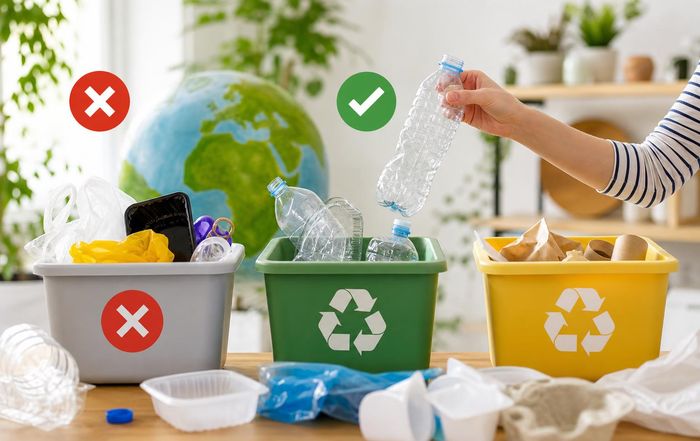
Sorting Plastics at Home: Common Mistakes to Avoid
Many households now sort their recycling as a matter of routine, but plastic is still where confusion reigns. Symbols that look alike can mean very different things, local rules vary, and well-intentioned "wishcycling" (tossing something in the bin in the hope it's recyclable) can contaminate entire loads. Understanding a few core principles can dramatically increase how much of your plastic actually gets recycled and reduce waste across the system.
This educational guide looks at the most common mistakes people make when sorting plastics at home, why they matter, and how to fix them in simple, practical ways. It focuses on curbside and drop-off systems used in many countries, but the underlying ideas apply almost everywhere. For broader habits beyond plastics, you may also find our updated pages on sustainable living, waste, and plastic recycling helpful companions.
Mistake 1: Assuming Every Plastic Item Is Recyclable
One of the biggest misunderstandings is the belief that any plastic with a recycling symbol can be recycled in household systems. The triangle with a number inside (often 1-7) is a resin identification code, not a universal "recyclable" label. It simply tells manufacturers and recyclers what type of plastic it is. Whether your local program accepts that type depends on market demand, sorting technology, and contracts with recyclers.
In many regions, the most commonly accepted plastics are PET (#1), used in clear drinks bottles, and HDPE (#2), used in milk jugs and some detergent bottles. Some programs also accept PP (#5), used in yogurt pots and some takeaway containers, but others do not. Mixed plastics, multi-layer films, and less common resins (like #3 PVC or #7 "other") are often not accepted curbside, even if they carry a triangle symbol. Organizations such as the U.S. Environmental Protection Agency (EPA) and the European Environment Agency (EEA) emphasize that local guidance always overrides the symbol.
The simplest fix is to check your municipality's recycling guide-usually on a city or waste-management website-and follow it strictly. If it says "bottles, jugs, and tubs only," stick to those shapes and ignore other plastic items, even if they display a triangle. For readers interested in the bigger picture of what happens next, our page on climate change gives context on how plastic production and disposal connect to emissions.
Mistake 2: Confusing "Biodegradable," "Compostable," and "Recyclable"
As more "eco-friendly" packaging appears, labels like "biodegradable," "compostable," or "plant-based" can mislead people into treating these items like ordinary recyclable plastics. Many compostable plastics are designed to break down only in industrial composting facilities with controlled temperature and humidity; they do not behave like conventional recyclable plastics in sorting plants. When compostable cups or bags end up in plastic recycling streams, they can lower material quality.
Similarly, "biodegradable" is a vague term and often not backed by robust standards. An item might biodegrade eventually under certain conditions, but that does not make it suitable for your home compost or recycling bin. The European Commission and agencies like France's ADEME have warned about greenwashing around these terms, while standards bodies such as ASTM International (astm.org) and DIN (din.de) define technical criteria that most consumers never see on the front of the package.
As a rule of thumb, do not place compostable or biodegradable plastics in your plastic recycling unless your local authority explicitly tells you to. If you have access to industrial composting through a food-waste collection service, follow its rules; many still do not accept compostable plastics. If you compost at home, confirm via credible sources like your local waste authority or organizations such as WRAP in the UK (wrap.org.uk) whether a particular product is suitable. When in doubt, treat ambiguous "green" plastics as general waste rather than contaminating recycling streams.
Mistake 3: Leaving Food and Liquid in Containers
Dirty plastics are one of the main reasons loads of recyclables are downgraded or landfilled. Residual food, oil, or drink can attract pests, grow mold, and soak into paper and cardboard in mixed recycling systems, making them unrecyclable. Even in plastic-only collections, heavy contamination forces facilities to spend more on cleaning or to reject material outright.
Recycling facilities and agencies such as Recycle Now in the UK (recyclenow.com) and Earth911 (earth911.com) generally recommend a simple standard: empty, quick rinse, and dry. Containers do not have to be spotless, but obvious residues should be removed. For example, scrape out yogurt pots with a spoon and give them a brief rinse; empty bottles fully and swish with a little water if needed. Allowing items to drain before putting them in the bin also helps prevent smells and mold.
People sometimes worry that rinsing uses too much water. In practice, using leftover dishwater or a small amount of cold water is usually sufficient and has far less environmental impact than losing whole batches of recyclables to contamination. If an item would require lots of hot water and detergent to get clean (for instance, a heavily greased film tray), it may be better placed in the general waste or managed through a specialized drop-off program if available.
Mistake 4: Bagging Recyclables in Plastic Bags
Another widespread issue is placing otherwise recyclable plastics inside plastic bags. Many sorting facilities use automated optical scanners and air jets to separate materials on fast-moving conveyor belts. Opaque or tied bags cannot be easily opened or sorted by machine, and workers often do not have time to open them manually. As a result, bagged recyclables are frequently treated as contamination and sent to landfill or incineration.
In many cities, waste companies and local authorities explicitly state: "Do not bag recycling; place items loose in the bin." Organizations such as The Recycling Partnership in the United States (recyclingpartnership.org) and GreenBlue (greenblue.org) highlight bagged material as a major operational challenge. Thin film bags themselves-like grocery bags, bread bags, and shrink wrap-also tangle in machinery and are often not accepted curbside.
The best practice is to put plastic items loose into the recycling bin and reuse any collection bags for other purposes or return them to designated film collection points if your area has them (often at supermarkets). If your municipality does require or provide clear recycling bags, make sure you use the specified type and do not tie them so tightly that they cannot be opened easily. For broader tips on reducing reliance on single-use bags and packaging, our lifestyle section explores reusable options and everyday behavior shifts.
Mistake 5: Mixing Flexible Films with Rigid Plastics
At first glance, a crinkly snack packet or soft plastic wrapper seems similar to a rigid plastic tub-it is all "plastic," after all. But flexible films behave very differently in recycling plants. They can wrap around sorting equipment, clog screens, and interfere with optical scanners designed for rigid shapes. Even when some flexible films are technically recyclable, many curbside systems are not equipped to handle them safely or economically.
Examples of problematic flexible plastics include cling film, crisp and snack packets, plastic wrap around multi-packs, bubble wrap, and many mailing envelopes. These often contain layers of different polymers and sometimes metalized coatings, which are difficult to separate. Organizations such as PlasticsEurope (plasticseurope.org) and the Ellen MacArthur Foundation (ellenmacarthurfoundation.org) point out that designing mono-material, recyclable films is an active area of innovation, but most household systems are still catching up.
Where available, separate collection schemes for soft plastics-often at supermarkets or special drop-off points-are a better route for these materials. If your area has no such option, flexible films usually belong in the general waste, not in the plastic recycling bin. Reducing their use by buying in bulk, choosing unpackaged produce, or selecting products in recyclable paper or rigid plastic can be even more effective than trying to recycle them later. For more on how innovation and packaging design are evolving, see our page on innovation.
Mistake 6: Ignoring Local Rules and Changes Over Time
Recycling is highly local. Two neighboring towns can have very different rules, depending on their contracts with material recovery facilities and end-markets for specific plastics. These rules also change over time as economics, technology, and regulations evolve. For instance, several countries have tightened contamination standards for exported plastic waste in recent years, prompting some cities to narrow what they accept.
Relying on assumptions, old leaflets, or advice from friends in other regions can lead to systematic mis-sorting. Official sources such as your city council, waste hauler, or national environmental agency are usually the best reference. In the United States, state and city websites often link to tools like How2Recycle (how2recycle.info), which offers standardized labels; in Europe, local authorities frequently publish updated guidance aligned with EU directives available via the European Commission's environment portal (ec.europa.eu).
It is worth revisiting local instructions at least once a year or whenever you move house. Some municipalities also provide apps or email alerts when rules change. Aligning your household routine with these updates is one of the most impactful steps you can take, because it directly supports how real facilities operate rather than an idealized version of recycling. If you are interested in how these systems intersect with business models and policy, our sustainable business and business pages explore those dimensions.
Mistake 7: "Wishcycling" Difficult Items
"Wishcycling" describes the hopeful act of putting questionable items into the recycling bin in the belief that "they'll figure it out at the plant." Common culprits include plastic toys, hangers, toothbrushes, cutlery, garden furniture, and mixed-material products like electronic accessories. While some of these may be made of recyclable resins, they often contain metal parts, electronics, or incompatible plastics, and they do not match the shapes and sizes that sorting equipment is calibrated to recognize.
Waste-management organizations and NGOs such as Greenpeace (greenpeace.org) and Zero Waste Europe (zerowasteeurope.eu) argue that wishcycling can be more harmful than simply placing non-recyclable items in general waste. Contaminants increase processing costs, lower the value of sorted bales, and sometimes damage machinery. In extreme cases, facilities may tighten acceptance rules, reducing overall recycling rates.
The practical alternative is a hierarchy: reduce and reuse first, then recycle what is clearly accepted, and finally dispose of the rest responsibly. For hard-to-recycle plastics, look for specialized take-back schemes from manufacturers, retailers, or community organizations. Some electronics brands and retailers, for example, offer collection points for accessories and small devices that contain plastic alongside metals. Our global and environmental awareness sections regularly discuss broader systemic efforts to phase out problematic plastics.
Mistake 8: Not Flattening, Squashing, or Sorting by Shape
Many local programs now instruct residents to focus on "bottles, jugs, tubs, and trays" rather than resin numbers alone. That is because modern sorting lines often rely on shape recognition as much as on material properties. Rigid hollow containers behave predictably on conveyor belts; they roll, bounce, and are easier for optical scanners to identify. Odd shapes, very small items, or large bulky objects can confuse these systems.
Leaving air in bottles and jugs also wastes space, meaning collection trucks fill up sooner and burn more fuel per unit of material. Agencies such as CalRecycle in California (calrecycle.ca.gov) and Environment and Climate Change Canada (ec.gc.ca) generally recommend crushing or squashing bottles and replacing caps, provided your local guide allows caps. Flattened items stack better and make collection more efficient, though they should still be recognizable as the right material.
On the other hand, items that are too small-like plastic straws, cutlery, or pieces smaller than a credit card-are unlikely to be captured and may fall through gaps in sorting screens. Even if they are technically recyclable, they can end up as residual waste or pollution. Whenever possible, avoid these small single-use items altogether, rather than hoping they will be recovered.
Mistake 9: Overlooking Non-Packaging Plastics and Hazardous Contamination
Not all plastics are equal from a safety perspective. Items that have contained hazardous materials-such as motor oil, pesticides, certain cleaning chemicals, or automotive fluids-are often excluded from household recycling. Residues can pose risks to workers and contaminate other materials. Similarly, medical plastics like syringes, tubing, or pill bottles with remaining medication require special handling and should never be placed in standard recycling.
National health and environment agencies, such as the World Health Organization (who.int) and Public Health England (now part of the UK Health Security Agency, gov.uk), stress the importance of safe disposal routes for medical and chemical waste. Pharmacies in many countries run take-back schemes for expired medicines and associated packaging; automotive service centers often accept used oil containers and similar items.
If a plastic item has held something hazardous, treat it as hazardous waste unless your local authority clearly states otherwise. Check municipal or regional guidance for drop-off days, special depots, or return programs. This extra step protects workers and the environment and helps maintain trust in recycling systems as safe and responsible.
Mistake 10: Focusing Only on Recycling Instead of Reduction and Reuse
Even perfect sorting cannot fully solve the environmental impact of plastics. Global plastic production continues to rise, and only a fraction of all plastic ever made has been recycled into new products. Organizations such as the UN Environment Programme (unenvironment.org) and the OECD (oecd.org) underline that reducing plastic use and designing systems for reuse are at least as important as recycling.
At household level, that means looking upstream: choosing products with minimal or easily recyclable packaging, refilling containers where possible, carrying reusable bags and bottles, and supporting businesses that offer repair, refill, or deposit schemes. For example, buying larger containers of staple foods rather than multiple small ones can reduce total packaging, and selecting items in clear PET or HDPE increases the chance that what you do buy will be recycled effectively.
Recycling remains a crucial part of a more circular economy, but it works best when combined with conscious consumption and policy measures like extended producer responsibility, deposit-return systems, and design standards. Our pages on economy, technology, and design explore how innovation and regulation are beginning to reshape the plastics landscape at scale.
Turning Better Sorting into a Daily Habit :)
Avoiding common mistakes in plastic sorting is less about memorizing every resin code and more about adopting a few durable habits: follow local rules rather than symbols, keep recyclables reasonably clean and loose, separate flexible films from rigid containers, and resist the urge to wishcycle doubtful items. Checking your municipality's guidance once in a while and talking with neighbors, schools, or local businesses about consistent practices can amplify your impact well beyond your own bin.
For those looking to go further, exploring topics like education and personal well-being can help connect everyday choices about plastics to broader goals-cleaner communities, healthier oceans, and a more sustainable relationship with the materials we use. Thoughtful sorting may feel like a small act, but multiplied across millions of households, it becomes a powerful signal that the world is ready for systems designed to keep resources in use and out of the environment.
